


MBA vs PGDM vs M.Com: Which Is Better Among PG Courses in India?
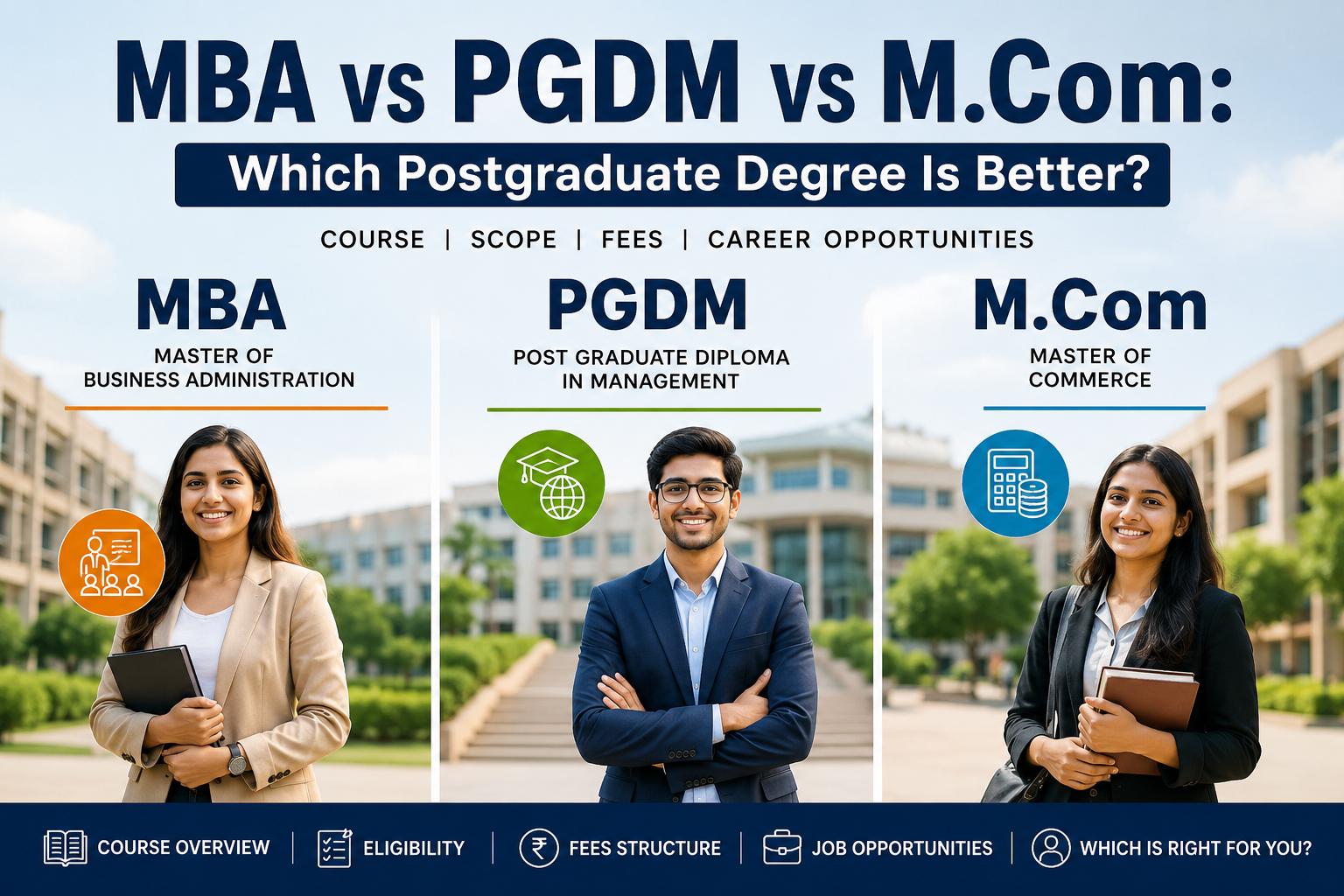
Graduating from college is an exciting milestone, but it often comes with a tough question: what comes next? As you explore various PG Courses in India, you will quickly realize that higher education opens doors to better roles and higher pay. However, picking the right path can feel overwhelming.
If you are looking at management, business, or finance, three popular options dominate the list: Master of Business Administration (MBA), Post Graduate Diploma in Management (PGDM), and Master of Commerce (M.Com).
While these postgraduate degree programs may seem similar at first glance, they serve very different goals. This post breaks down the differences, costs, eligibility, and real-world outcomes so you can choose the right degree for your future.
MBA, PGDM and M.Com – What Is the Basic Difference?
Understanding the foundation of each program is the first step toward making an informed choice.
MBA Course Details
An MBA Program is a traditional degree offered by universities or colleges affiliated with a central or state university. Because public universities regulate these degree programs, the curriculum follows a structured academic framework.
It focuses on core management theory, covering leadership, business strategy, marketing, and human resources. An MBA degree holds strong global recognition due to its formal degree status.
PGDM Course Details
A PGDM is a diploma program offered primarily by autonomous institutes recognized by the All India Council for Technical Education (AICTE). Since these institutes do not wait for university board updates, they update their curriculum frequently to match current industry demand.
You will find a heavy focus on case studies, practical simulations, industry projects, and corporate exposure. When an autonomous body gains AIU (Association of Indian Universities) equivalence, its PGDM is treated on par with a standard degree.
M.Com Course Details
An M.Com is a specialized academic degree focusing heavily on accounting, taxation, economics, auditing, and corporate finance. Unlike management programs that build overall business leadership, an M.Com builds deep technical expertise in financial domain knowledge.
It is ideal if you want to enter core accounting, teaching, research, or specialized banking roles.
MBA vs PGDM vs M.Com – Quick Comparison
Here is how these postgraduate courses in India stack up side by side:
| Parameter | MBA | PGDM | M.Com |
| Course Type | Degree (University affiliated) | Diploma (Autonomous AICTE institutes) | Degree (University affiliated) |
| Typical Duration | 2 Years | 2 Years | 2 Years |
| Eligibility | Bachelor’s degree (45–50%) + Entrance exam | Bachelor’s degree (50%) + Entrance exam | B.Com / BBA / Relevant UG degree |
| Curriculum Focus | Business theory & management principles | Practical exposure & dynamic industry needs | Advanced accounting, finance & taxation |
| Fees Range | ₹1.5 Lakh to ₹20+ Lakh | ₹4 Lakh to ₹25+ Lakh | ₹20,000 to ₹2 Lakh |
| Career Direction | Corporate leadership, management & strategy | Corporate management, startups & consulting | Accounting, banking, auditing & academia |
| Ideal Candidate | Wants an affordable, globally recognized degree | Wants industry-ready practical training | Wants deep subject mastery in finance/accounting |
Eligibility and Admission Process
Getting into the best PG courses after graduation requires planning ahead for entry requirements and application deadlines.
PG Course Eligibility
For both MBA and PGDM programs, you generally need a bachelor’s degree in any discipline with at least 50% aggregate marks (45% for reserved categories).
For M.Com, most universities require a background in Commerce (B.Com) or related management fields (BBA).
Entrance Exams
-
MBA & PGDM: Most recognized institutes accept scores from national exams like CAT, XAT, MAT, CMAT, or state-level exams like MAH-CET. Some private institutions and deemed universities conduct their own entrance tests.
-
M.Com: Admissions are often merit-based (college marks) or cleared through university-specific entrance tests.
Documents and Application Considerations
Keep your mark sheets, identity proofs, graduation certificates, and entrance scorecards organized. Many management institutes also require a Statement of Purpose (SOP) and letters of recommendation.
Guidance for International Applicants
If you are an international applicant, you must check visa guidelines, passport validity, and equivalence certificates from the Association of Indian Universities (AIU). Many institutions simplify this process through dedicated international admission cells.
Course Fees and Return on Investment
Knowing PG course fees helps you set a realistic budget and set expectations for your career return.
Total Program Cost vs. Career Placement Value = Real ROI
Understanding the Cost Breakdown
-
Public Universities (MBA/M.Com): Usually offer low tuition fees ranging from ₹20,000 to ₹2 Lakh for the full course.
-
Autonomous B-Schools (PGDM/Private MBA): Require a higher investment, ranging from ₹5 Lakh to ₹25 Lakh, as they include modern infrastructure, guest lectures, and corporate immersion.
Evaluating ROI Instead of Just Upfront Cost
Never evaluate a program on cost alone. A low-cost program with zero campus placements might cost you more in lost time than a higher-priced program that connects you to top employers.
Look at the average placement packages, active recruiter networks, and alumni success stories to gauge the real return on investment (ROI).
Career Opportunities After MBA, PGDM and M.Com
Your post-graduation path depends heavily on the specialized skills you build during your two-year study.
Management Path  ---> Strategy, Leadership & Consulting
Commerce Path    ---> Financial Analysis, Taxation & Auditing
Management and Leadership Roles
Both MBA and PGDM graduates land leadership roles across private and public sectors. Common profiles include Project Manager, Business Analyst, Strategy Consultant, and Operations Lead.
Marketing, Finance, HR, and Operations
-
Marketing: Brand Manager, Digital Strategy Lead, Product Manager.
-
Finance: Investment Banker, Financial Analyst, Risk Manager.
-
HR: Talent Acquisition Manager, HR Business Partner.
-
Operations: Supply Chain Analyst, Logistics Coordinator.
Accounting, Banking, Taxation, and Commerce Careers
An M.Com graduate excels in specialized financial roles. Popular options include Senior Accountant, Auditor, Tax Consultant, Financial Controller, and Commercial Banker. It is also the preferred foundation if you plan to clear exams like CA, CS, or UGC-NET for lectureships.
Which Course Is Better for Your Career Goals?
There is no single "best" program—only the program that aligns with your budget, background, and career plans.
Choose MBA if:
-
You want a traditional, university-awarded Master’s degree.
-
You plan to apply for government jobs or foreign doctoral programs that require a formal degree.
-
You prefer a balanced mix of academic management theory and practical knowledge.
Choose PGDM if:
-
You want an agile curriculum updated every year to meet industry standards.
-
You value practical corporate exposure, internships, case studies, and skill-building workshops.
-
You want to work in fast-paced sectors like IT, consulting, digital marketing, or fintech.
Choose M.Com if:
-
You love numbers, accounting laws, taxation, and auditing.
-
You want an affordable degree program without taking on heavy student debt.
-
You plan to enter academia, teaching, or research, or prepare for professional finance certifications.
PG Courses in India for International Students
India has become a vibrant hub for foreign students looking for quality higher education at an affordable cost. The blend of rich cultural diversity and modern academic frameworks makes studying here a life-changing experience.
If you are looking for the best international university in India experience, institutional support matters just as much as classroom teaching.
For instance, within the Symbiosis ecosystem, the Symbiosis Centre for International Education (SCIE) serves as a dedicated department for foreign national students. It handles everything from international admissions Process and visa compliance to cultural orientation programs.
This kind of structural support helps international students adjust smoothly to student life in India.
Conclusion
Choosing between an MBA, PGDM, or M.Com comes down to your personal goals. If you want a flexible, corporate-driven career with hands-on exposure, a PGDM is a strong pick. If you want a globally recognized academic degree in leadership, choose an MBA. If your heart is set on deep financial expertise or teaching, M.Com is the clear winner.
Take time to evaluate PG Courses in India based on your budget, preferred learning style, and long-term career vision. When you align your degree with your natural strengths, you set yourself up for lasting professional success.
Frequently Asked Questions
Which is better: MBA, PGDM or M.Com?
None is universally better. A PGDM offers practical corporate skills, an MBA offers a structured university management degree, and an M.Com offers specialized training in accounting and finance. Choose the program that matches your career path.
Is PGDM equivalent to an MBA?
Yes, a PGDM is equivalent to an MBA if the offering institute is AICTE-approved and holds an equivalence certificate from the Association of Indian Universities (AIU).
Which course is better for a career in finance?
If you want to work in corporate finance, investment banking, or financial strategy, an MBA or PGDM in Finance is ideal. If you want a career in auditing, taxation, core accounting, or banking, an M.Com provides deeper technical knowledge.
Can international students pursue PG courses in India?
Yes, international students can easily enroll in Indian postgraduate programs. Many institutions have specialized departments, such as the Symbiosis Centre for International Education (SCIE) at Symbiosis, to assist foreign students throughout admission and campus integration.
What should I check before choosing a postgraduate program?
Always check institution approval (UGC/AICTE/AIU), updated curriculum structure, past placement records, real faculty experience, total fee structure, and alumni outcomes before enrolling.

 English
 Arabic
 French
 Portuguese
 Deutsch
 Turkish
 Dutch
Dutch
 Italiano
 Russian
 Romaian
 Portuguese (Brazil)
 Greek
Greek