


Is B.Tech in Electrical Engineering a Good Career Choice After 12th in 2026?
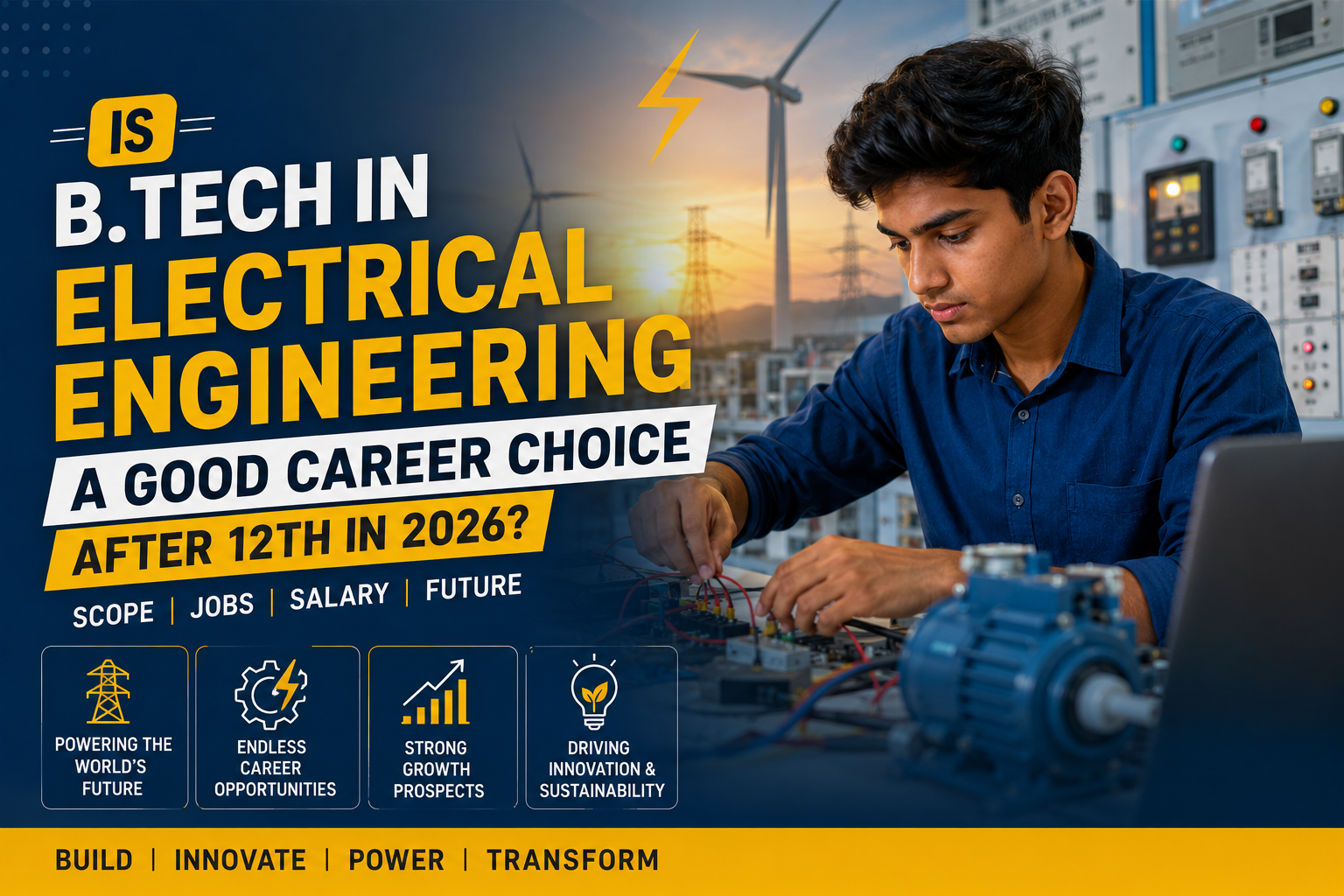
Choosing the right branch after Class 12 PCM is one of the most stressful decisions you will make. With everywhere you look focused on Computer Science, Data Science, and Artificial Intelligence, it is easy to wonder if traditional branches still offer a strong career. You might be asking yourself if choosing B.Tech in Electrical Engineering in 2026 makes sense, or if you will be left behind in a tech-driven market.
Here is the truth: while software trends come and go, physical infrastructure and energy systems run the modern world. Electrical Engineering is far from outdated. In fact, it is undergoing one of its most exciting transformations in decades due to electric vehicles, renewable energy transition, and smart automation.
By the end of this guide, you will have a clear, realistic picture of the course, its real difficulty level, career paths, salaries, and whether it aligns with your personal strengths.
What Is B.Tech in Electrical Engineering?
A B.Tech in Electrical Engineering course is an undergraduate four-year professional degree focused on the study, design, and application of equipment, devices, and systems that use electricity, electronics, and electromagnetism.
Course Details at a Glance
| Parameter | Details |
| Degree Level | Undergraduate (B.Tech / B.E.) |
| Duration | 4 Years (8 Semesters) |
| Core Focus | Power generation, circuit design, control systems, energy storage, smart grids |
| Practical Exposure | Heavy laboratory work, simulation software, industrial visits, project work |
What the Field Actually Covers
Many students assume electrical engineering is just about household wiring, transformers, and power lines. In reality, modern electrical engineering covers high-voltage power generation down to micro-level control circuits. You study how to convert energy, control heavy motors, process electrical signals, and manage power grids safely.
Electrical Engineering vs. Basic Electronics
It helps to understand the difference between Electrical Engineering (EE) and Electronics & Communication Engineering (ECE):
-
Electrical Engineering (EE): Focuses primarily on heavy current, high voltage, power generation, electric motors, power electronics, and large-scale distribution grids.
-
Electronics Engineering (ECE): Focuses on light current, low voltage, semiconductor chips, microprocessors, signal processing, and telecommunication devices.
Who Should Consider This Branch?
This program suits you if you enjoy understanding how physical machines work, have a strong grasp of physics concepts like electromagnetism and current electricity, and like solving analytical, math-heavy problems.
What Will You Study in B.Tech Electrical Engineering?
The curriculum balances core physical science theory with practical engineering applications. Here are the main Electrical Engineering subjects you will cover over four years:
[Year 1: Foundations] ➔ [Year 2: Core Circuits & Math] ➔ [Year 3: Heavy Systems & Controls] ➔ [Year 4: Automation & Projects]
-
Engineering Mathematics: Linear algebra, differential equations, complex variables, and transform calculus. Math forms the backbone of circuit analysis and control modeling.
-
Circuit Theory & Network Analysis: Learning how electrical networks behave, calculating voltage and current across complex circuits, and analyzing transient responses.
-
Electrical Machines: The study of transformers, DC motors, synchronous generators, and induction motors—understanding their working principles, efficiency, and magnetic circuits.
-
Power Systems: Covering power generation (thermal, hydro, solar), transmission line design, fault analysis, and distribution grid management.
-
Control Systems: Understanding how to automate systems using feedback loops—used everywhere from industrial robotic arms to aircraft stability control.
-
Power Electronics: Studying solid-state switches (IGBTs, MOSFETs) that convert electrical power efficiently. This is the core technology behind EV battery chargers, solar inverters, and motor drives.
-
Electrical Measurements & Instrumentation: How to accurately measure physical quantities using sensors, oscilloscopes, transducers, and digital meters.
-
Renewable Energy & Smart Automation: Modern curricula include solar photovoltaic systems, wind turbines, microgrids, Programmable Logic Controllers (PLCs), SCADA systems, and basic Python or C++ programming for embedded systems.
Rather than just memorizing formulas, you learn how to simulate electrical circuits using software like MATLAB/Simulink and apply those concepts in physical laboratories.
B.Tech Electrical Engineering Eligibility and Admission 2026
If you are planning your B.Tech Electrical Engineering admission 2026 process, keep in mind that criteria can vary depending on whether you target national institutes, state universities, or private colleges.
Eligibility Criteria
-
Academic Qualification: You must pass your Class 12 (or equivalent) examination from a recognized board.
-
Subject Requirements: Physics, Chemistry, and Mathematics (PCM) are mandatory core subjects.
-
Minimum Marks: Most institutions require an aggregate of 50% to 60% in PCM (relaxations apply for reserved categories).
Admission Process & Entrance Exams
-
National-Level Entrance Exams: JEE Main and JEE Advanced open doors to IITs, NITs, and IIITs.
-
State-Level Entrance Exams: Exams like MHT-CET, WBJEE, KCET, and TNEA offer entry into top state government and private colleges.
-
University-Specific Exams: Institutions like VIT (VITEEE), Manipal (MET), and SRM (SRMJEEE) conduct their own entrance tests.
-
Merit-Based / Direct Admission: Some private universities grant admissions based on Class 12 board marks or management quota seats, subject to state regulatory norms.
Essential Documents Needed
-
Class 10 and Class 12 mark sheets and passing certificates.
-
Entrance exam scorecard (JEE Main, MHT-CET, etc.).
-
Category/Caste certificate (if applicable).
-
Domicile and Migration certificates.
-
Identification proof (Aadhaar Card).
B.Tech Electrical Engineering Fees and Course Duration
The course runs across a standard 4-year duration, divided into 8 semesters. B.Tech Electrical Engineering fees vary widely based on the institution's funding model and infrastructure.
[Government Institutes: ₹2 Lakhs - ₹10 Lakhs Total] <---> [Private Universities: ₹6 Lakhs - ₹20 Lakhs Total]
Fee Structure Breakup
-
Government Institutions (IITs, NITs, State Colleges): Total tuition fees range from ₹2,000,000 to ₹10,000,000 for the full 4-year duration. Subsidies and fee waivers are available for eligible categories.
-
Private Universities & Colleges: Total tuition fees range between ₹6,000,000 and ₹20,000,000, depending on tier, location, and campus facilities.
Additional Costs to Budget For
Beyond base tuition, you should budget for:
-
Hostel and Mess Fees: ₹60,000 to ₹1,500,000 per year.
-
Laboratory & Caution Deposits: One-time refundable fees ranging from ₹5,000 to ₹20,000.
-
Project & Component Expenses: Final-year hardware projects, safety gear, and specialized software access (₹10,000 to ₹30,000).
Scope of Electrical Engineering in India in 2026
The Electrical Engineering scope in India is undergoing a massive shift. It is no longer restricted to traditional power plants. Four major technology trends are fueling new opportunities:
                     ┌──► Electric Mobility (EVs & Battery Tech)
                     │
Scope Drivers 2026 ──┼──► Renewable Energy & Smart Grids
                     │
                     ├──► Industrial Automation & Robotics
                     │
                     └──► Semiconductor & Chip Manufacturing
-
Electric Vehicles (EVs): The EV transition relies heavily on electrical engineers to design motor controllers, battery management systems (BMS), power converters, and charging networks.
-
Renewable Energy Expansion: With India targeting aggressive clean energy goals, large-scale solar parks, wind farms, and energy storage systems require skilled power engineers.
-
Smart Grids & Automation: Modernizing the national power grid using IoT sensors, AI load prediction, and SCADA systems needs engineers who understand both power systems and software integration.
-
Industrial Automation & Railways: Manufacturing plants, metro rail networks, and high-speed rail corridors depend on electrical expertise for motor drives, traction control, and safety automation.
-
Government & PSUs: Public Sector Undertakings (PSUs) like NTPC, POWERGRID, BHEL, IOCL, and Indian Railways consistently recruit core electrical engineers through GATE examination scores.
Jobs After B.Tech in Electrical Engineering
Graduating with an electrical engineering degree gives you access to varied core technical job roles:
-
Electrical Design Engineer: Creates schematics, wiring layouts, and control panel designs for industrial machines or buildings using tools like AutoCAD Electrical.
-
Power Systems Engineer: Works on grid stability, power distribution networks, high-voltage transformers, and substation maintenance.
-
Control & Automation Engineer: Programs PLCs, SCADA systems, and industrial robotics to run automated factory production lines.
-
EV Powertrain / Battery Engineer: Designs and tests electric motors, battery management systems, and thermal cooling loops in automotive companies.
-
Maintenance & Plant Engineer: Ensures continuous operation, safety checks, and fault troubleshooting of heavy machinery in manufacturing plants.
-
Renewable Energy Engineer: Focuses on solar grid integration, wind turbine systems, and power conversion units.
Electrical Engineering Salary and Placement Package
Your starting Electrical Engineering salary in India depends on your college tier, practical skills, industry sector, and hands-on project exposure.
                     ┌──► Core Private Companies: ₹4.0 - ₹8.0 LPA
                     │
Fresher Package ─────┼──► Public Sector Units (PSUs): ₹8.0 - ₹18.0 LPA
                     │
                     └──► Tech / EV / Automation Roles: ₹6.0 - ₹12.0 LPA
Realistic Salary Ranges
-
Core Private Sector Freshers: Entry-level roles at core manufacturing or engineering firms typically offer ₹3.5 LPA to ₹6.5 LPA.
-
Top Product, EV, or Automation Firms: Roles in specialized EV development, power electronics, or semiconductor firms offer ₹6.0 LPA to ₹12.0 LPA for freshers with strong domain skills.
-
PSU Recruitments (Via GATE): Public sector units offer structured packages ranging from ₹8.0 LPA to ₹18.0 LPA, along with government perks and security.
Core vs. Non-Core Opportunities
Many electrical engineering graduates also transition into software development, data analytics, or technical consulting. Because electrical engineering builds strong mathematical logic, IT recruiters value EE students who have added programming skills (like Python, C++, or SQL) to their core knowledge base.
Is Electrical Engineering Difficult?
Let's address this concern directly: Yes, Electrical Engineering is considered one of the more challenging engineering branches.
Why it feels challenging: Unlike civil or mechanical engineering, where you can physically see structures or gears moving, electricity is invisible. You must visualize abstract concepts like electromagnetic fields, phase shifts, and transient frequencies through mathematical models.
Where Students Face Difficulty
-
Heavy Applied Mathematics: Differential equations and complex calculus are used constantly to solve circuit behavior.
-
Physics Integration: Deep understanding of electromagnetism, vector calculus, and thermodynamics is necessary.
-
Logical Circuit Analysis: Troubleshooting complex, multi-component circuit diagrams requires high analytical patience.
If you enjoy conceptual problem-solving and are comfortable with math, the difficulty is manageable and rewarding. However, if you strongly dislike physics and mathematics, you will likely find the coursework demanding.
Electrical Engineering vs. Other Engineering Branches
Comparing branches helps put your choice into perspective:
| Branch | Primary Focus | Key Subjects | Best For Students Who Want |
| Electrical Engineering | Heavy power, motors, energy conversion, automation | Power Systems, Machines, Power Electronics | Work in clean energy, EVs, core industries, or PSUs |
| Electronics (ECE) | Microchips, wireless communication, signal processing | VLSI, Embedded Systems, Digital Signals | Work in consumer electronics, telecom, or semiconductor design |
| Mechanical Engineering | Physical structures, thermal systems, manufacturing | Dynamics, Thermodynamics, Fluid Mechanics | Design physical hardware, engines, and mechanical structures |
| Computer Science (CSE) | Software systems, algorithms, database management | Data Structures, Web Dev, OS, AI/ML | Focus purely on software development, coding, and digital products |
Who Should Choose B.Tech in Electrical Engineering After 12th?
This course is a great match for you if:
-
You naturally perform well in Class 12 Physics (especially Magnetism and Current Electricity) and Mathematics.
-
You are excited by future technologies like Electric Vehicles, solar power grids, and smart hardware.
-
You want a degree that opens doors to both government sector jobs (PSUs) and modern private tech industries.
-
You enjoy hands-on lab work, building hardware prototypes, and testing physical circuits.
Who Should Think Twice Before Choosing It?
You may want to reconsider or explore alternative options if:
-
You struggle significantly with Class 12 Physics and higher-level Mathematics.
-
You are selecting the branch solely based on peer pressure or generic advice without understanding the subject matter.
-
You want a career focused entirely on desk-based software coding and have zero interest in physical hardware, circuits, or machinery.
Is B.Tech in Electrical Engineering Worth It in 2026?
Yes, pursuing a B.Tech in Electrical Engineering is fully worth it in 2026—provided you build practical, modern skills.
The global push toward sustainability, clean energy, and automation has placed electrical engineers at the core of industrial growth. While generic theoretical knowledge alone is no longer enough, engineers who combine core electrical fundamentals with tools like MATLAB, PLC/SCADA programming, Python, and EV power electronics are in high demand.
It offers a durable, future-proof skill set that cannot be easily replaced by basic software automation.
Conclusion
Choosing to pursue a B.Tech in Electrical Engineering after Class 12 in 2026 is a sound career choice if you have an analytical mind and an interest in physical technology. The field offers a stable career path with growing opportunities across electric mobility, smart energy systems, and industrial automation.
Ultimately, the best engineering branch is not simply the one that is currently trending, but the one that aligns with your individual strengths, interests, and willingness to learn. If physical systems, power, and practical problem-solving excite you, Electrical Engineering will serve as a rewarding foundation for your career.
Frequently Asked Questions (FAQs)
1. Is Electrical Engineering a good career choice for the future?
Yes. The rapid growth of electric vehicles, solar and wind power integration, energy storage systems, and factory automation ensures long-term demand for skilled electrical engineers in India and abroad.
2. What is the minimum eligibility for B.Tech Electrical Engineering after 12th?
You need to pass Class 12 with Physics, Chemistry, and Mathematics (PCM) as core subjects from a recognized board, securing at least 50% to 60% aggregate marks, along with a valid entrance exam score (such as JEE Main or state CETs).
3. Is Electrical Engineering harder than Computer Science?
Electrical engineering is generally considered more mathematically intensive and abstract because you deal with non-visible physical phenomena like electromagnetic fields and high-voltage power dynamics. Computer Science focuses more on discrete mathematics, logic, and software design.
4. Can Electrical Engineering graduates work in the IT sector?
Yes. Many IT and software companies recruit electrical engineering graduates for software development, data analytics, and system integration roles, especially if the student possesses core programming skills in C++, Python, or Java.
5. Is Electrical Engineering good for government jobs?
Electrical Engineering is one of the top branches for government jobs. Major PSUs (NTPC, POWERGRID, BHEL, SAIL), State Electricity Boards, ISRO, DRDO, and Indian Railways regularly recruit electrical engineers through GATE or independent exams.

 English
 Arabic
 French
 Spanish
 Deutsch
 Turkish
 Dutch
Dutch
 Italiano
 Russian
 Romaian
 Portuguese (Brazil)
 Greek
Greek