


B.Tech in AI vs B.Tech in Computer Science: Which Is Better?
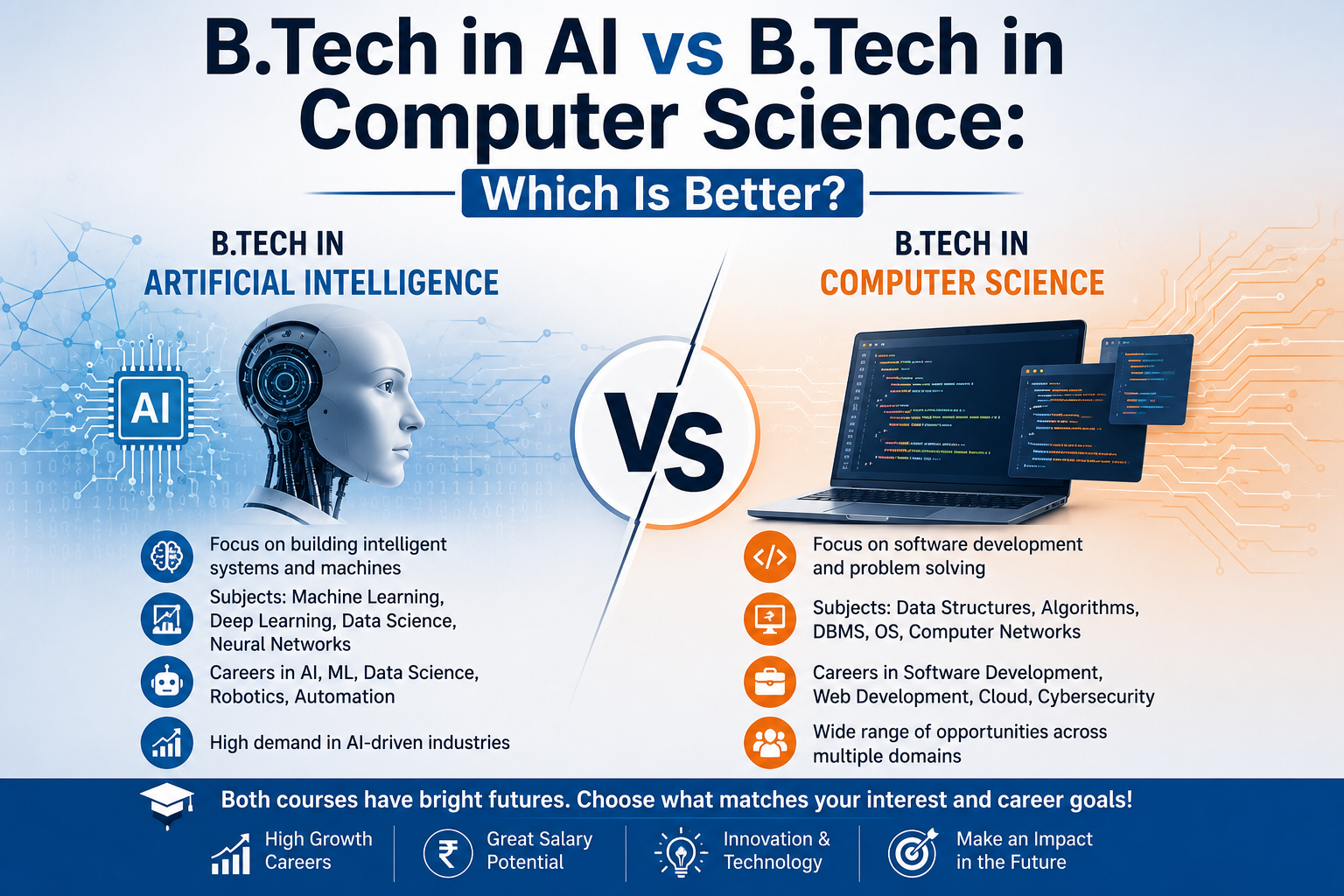
Class 12 results are out, and you stand at a major crossroads. You know you want to build a career in technology, but one big question keeps you up at night: Should you pick a B.Tech in Artificial Intelligence or go with the classic B.Tech in Computer Science?
Both options promise exciting careers, hands-on coding, and great opportunities. Millions of students across India look for the best B.Tech course after 12th every single year, trying to balance their passion with future job security.
The main difference comes down to specialization versus breadth. One path trains you deeply in smart algorithms and data right from day one, while the other gives you a complete foundation in all things computing.
In this comparison of B.Tech in AI vs B.Tech in Computer Science, we will break down the syllabus, fees, placement trends, and career paths to help you make the right choice.
What Is B.Tech in Artificial Intelligence?
B.Tech in Artificial Intelligence is a specialized four-year undergraduate degree designed for the modern data-driven world.
To join this program, you need to pass Class 12 with Physics, Chemistry, and Mathematics (PCM) with a valid score in engineering entrance exams like JEE Main or state-level tests.
This course focuses directly on creating intelligent systems that can learn, reason, and make decisions on their own.
If you love working with numbers, patterns, and logic, this specialized program might be your ideal fit.
You will pick up skills in data analysis, algorithm design, pattern recognition, and neural network training.
Keep in mind that this course requires a solid comfort level with advanced mathematics, linear algebra, and probability alongside regular programming languages like Python.
What Is B.Tech in Computer Science?
B.Tech in Computer Science (often called CSE) is the gold standard of technology education across global engineering institutes.
Like the AI specialization, it is a four-year program requiring a Science background in Class 12 with Physics, Chemistry, and Mathematics.
CSE covers the entire ecosystem of computing—from basic hardware interaction to high-level software development.
Choose CSE if you want complete career flexibility and want to keep your options open across different tech domains.
You learn core programming, system architecture, database design, and software engineering principles.
This broad foundation allows you to pivot into almost any technical role later in your career.
B.Tech in AI vs B.Tech in Computer Science – Key Differences
Here is a side-by-side view to help you compare both options quickly:
| Parameter | B.Tech in Artificial Intelligence | B.Tech in Computer Science (CSE) |
| Course Focus | Specialized focus on smart systems, machine learning, and data models. | Broad focus on software engineering, computing systems, and hardware basics. |
| Eligibility | Class 12 with Physics, Chemistry, and Mathematics (PCM). | Class 12 with Physics, Chemistry, and Mathematics (PCM). |
| Duration | 4 Years (8 Semesters) | 4 Years (8 Semesters) |
| Major Subjects | Machine Learning, Deep Learning, NLP, Data Science, Python. | Data Structures, Algorithms, DBMS, Operating Systems, Computer Networks. |
| Programming Focus | Python, R, C++, specialized AI libraries (TensorFlow, PyTorch). | Java, C, C++, Python, Web Development stacks. |
| Mathematics Depth | Heavy focus on Statistics, Linear Algebra, Calculus, and Probability. | Applied Mathematics, Discrete Mathematics, and Logic Design. |
| AI & ML Exposure | Deep, multi-year exposure starting early in the degree. | Basic introductory modules, or elective choices in final years. |
| Software Dev Focus | Applied mainly toward building and deploying data models. | Comprehensive focus on building full-scale software and web apps. |
| B.Tech Course Fees | ₹4 Lakhs to ₹15 Lakhs total (varies by private/government college). | ₹3 Lakhs to ₹12 Lakhs total (varies by private/government college). |
| Career Scope | High demand in specialized sectors like AI research, automation, and analytics. | Universal demand across all tech and non-tech industries. |
| Key Job Roles | AI Engineer, ML Engineer, Data Scientist, Computer Vision Specialist. | Software Developer, Full-Stack Developer, Systems Engineer, Cloud Architect. |
| Placement Opportunities | Specialized roles in tech firms, product startups, and research labs. | Massive hiring volume across IT services, product companies, and MNCs. |
| Higher Studies Options | M.Tech/MS in AI, Robotics, Data Science, or Cognitive Systems. | M.Tech/MS in Computer Science, Cybersecurity, AI, Management (MBA). |
Syllabus and Subjects – What Will You Actually Study?
B.Tech AI Syllabus
In this stream, your courses dive fast into statistical modeling, data handling, and automated reasoning:
-
Artificial Intelligence Fundamentals & Search Algorithms
-
Machine Learning & Predictive Analytics
-
Deep Learning & Neural Networks
-
Python Programming & Scientific Computing
-
Data Science & Big Analytics
-
Natural Language Processing (NLP)
-
Computer Vision & Image Processing
B.Tech CSE Syllabus
The B.Tech CSE syllabus builds a solid, well-rounded understanding of how computing systems operate end-to-end:
-
Object-Oriented Programming (Java, C++)
-
Data Structures & Algorithms
-
Database Management Systems (DBMS)
-
Operating Systems Design
-
Computer Networks & Security
-
Software Engineering Practices
-
Cloud Computing Architectures
Note: Exact course modules vary between universities, so always review the specific curriculum before taking admission.
Fees, Placement, Salary & Career Scope
When evaluating the difference between B.Tech AI and Computer Science, financial planning and career return matter a lot to parents and students.
B.Tech AI fees and B.Tech CSE fees generally fall in a similar range, though specialized AI programs in private universities sometimes carry a slight premium due to specialized lab setups.
During campus interviews, B.Tech Computer Science placement drives usually bring in a higher volume of recruiters because every tech company needs general software developers.
On the other hand, B.Tech AI placement drives tend to target specialized roles that demand specific skill sets right from day one.
After graduation, you can aim for various dynamic job roles:
-
Software Developer / Full-Stack Developer
-
AI Engineer
-
Machine Learning Engineer
-
Data Scientist / Data Analyst
-
Cloud Engineer
-
Cybersecurity Specialist
When looking at B.Tech AI salary and B.Tech CSE salary expectations, remember that no college can guarantee a fixed pay package.
Your starting salary depends on your personal skills, college reputation, practical projects, internship experience, job location, and hiring company.
Which Course Has Better Career Opportunities?
Both degrees open doors to thriving industries across India and abroad.
You can work in diverse sectors such as:
-
Information Technology & Cloud Services
-
Artificial Intelligence & Automation Labs
-
FinTech & Financial Services
-
Healthcare Technology & Bio-Informatics
-
E-commerce & Retail Logistics
-
Cybersecurity & Defense
Major technology hubs like Bengaluru, Hyderabad, Pune, Mumbai, Delhi NCR, Chennai, Kolkata, and Noida offer endless opportunities for fresh engineering graduates.
At the same time, students starting their journey in growing education centers like Patna can build strong careers by focusing early on practical coding, online certifications, and industry internships.
B.Tech AI or Computer Science – Which Should You Choose?
Making the right pick comes down to understanding your personal strengths and long-term interest.
       [What is your primary career goal?]
                       |
       +---------------┴---------------+
       |                               |
[Deep Specialization]         [Maximum Flexibility]
       |                               |
       v                               v
Pick B.Tech AI if you:        Pick B.Tech CSE if you:
• Love Math & Statistics      • Want broad tech options
• Want to build AI models     • Enjoy coding & app dev
• Like working with data      • Plan to specialize later
Choose B.Tech AI if you:
-
Love Mathematics, linear algebra, and statistical thinking.
-
Feel passionate about building smart algorithms, chatbots, and prediction tools.
-
Want to focus immediately on data science without taking extra general computing courses.
-
Prefer a specialized engineering path right from your first year.
Choose B.Tech Computer Science if you:
-
Want the widest possible range of job options after graduation.
-
Enjoy general coding, web development, app creation, and software building.
-
Feel unsure about picking a narrow specialization early in your life.
-
Want the freedom to move into AI, cybersecurity, cloud computing, or management later on.
Neither degree is universally "better" than the other—it simply depends on whether you want a broad foundation or an early specialization.
How to Choose the Right B.Tech College
Once you decide on the degree, picking the right best engineering university is your next big step.
Take time to evaluate these points before making your final choice:
-
Curriculum Modernity: Check if the syllabus updates regularly to match current industry trends.
-
Faculty Experience: Look for professors with active research background or industry experience.
-
Lab Infrastructure: Ensure the campus offers modern computing hardware and dedicated software environments.
-
Internship Support: Verify if the college actively helps students land practical summer internships.
-
Placement Track Record: Look at real placement trends rather than marketing highlights.
-
Affiliation & Recognition: Confirm proper university approvals and accreditations.
Always verify fee structures and course details directly on official university websites before filling out admission forms.
Conclusion
Choosing between a B.Tech in AI vs B.Tech in Computer Science comes down to balancing immediate specialization against long-term flexibility.
B.Tech AI gives you a direct, deep path into data science and intelligent systems, making it ideal if you already love math and data.
B.Tech Computer Science provides a comprehensive foundation in software engineering, giving you the flexibility to explore different tech fields before settling on a niche.
Assess your interests, review course syllabi, and pick the path that best matches your personal learning style and career goals.
Frequently Asked Questions
Which is better, B.Tech AI or B.Tech Computer Science?
Neither is strictly better; they serve different goals. B.Tech Computer Science offers broader flexibility across all tech fields, while B.Tech AI provides deep, focused training in machine learning and data science from the start.
Does B.Tech AI have more scope than CSE?
B.Tech AI has high specialized scope in data-heavy and automation industries. However, B.Tech CSE retains a wider overall scope because CSE graduates can work across software development, web engineering, cloud computing, and AI.
Which has a higher salary, AI or Computer Science?
Salary depends on individual coding skills, practical projects, college placement networks, and location rather than the degree name alone. Highly skilled graduates from both streams command competitive starting packages.
Can a B.Tech CSE student become an AI engineer?
Yes. B.Tech CSE students can easily become AI engineers by taking elective courses in machine learning, completing certifications, building personal AI projects, or pursuing a master's degree in AI.
Is B.Tech AI difficult for an average student?
B.Tech AI requires a strong commitment to mathematics, including statistics, calculus, and linear algebra. If you feel comfortable with high school math and enjoy analytical problem-solving, you can manage the course successfully.

 English
 Arabic
 French
 Spanish
 Portuguese
 Deutsch
 Turkish
 Dutch
Dutch
 Italiano
 Russian
 Romaian
 Portuguese (Brazil)