


Common Packaging Mistakes That Cost Businesses Money
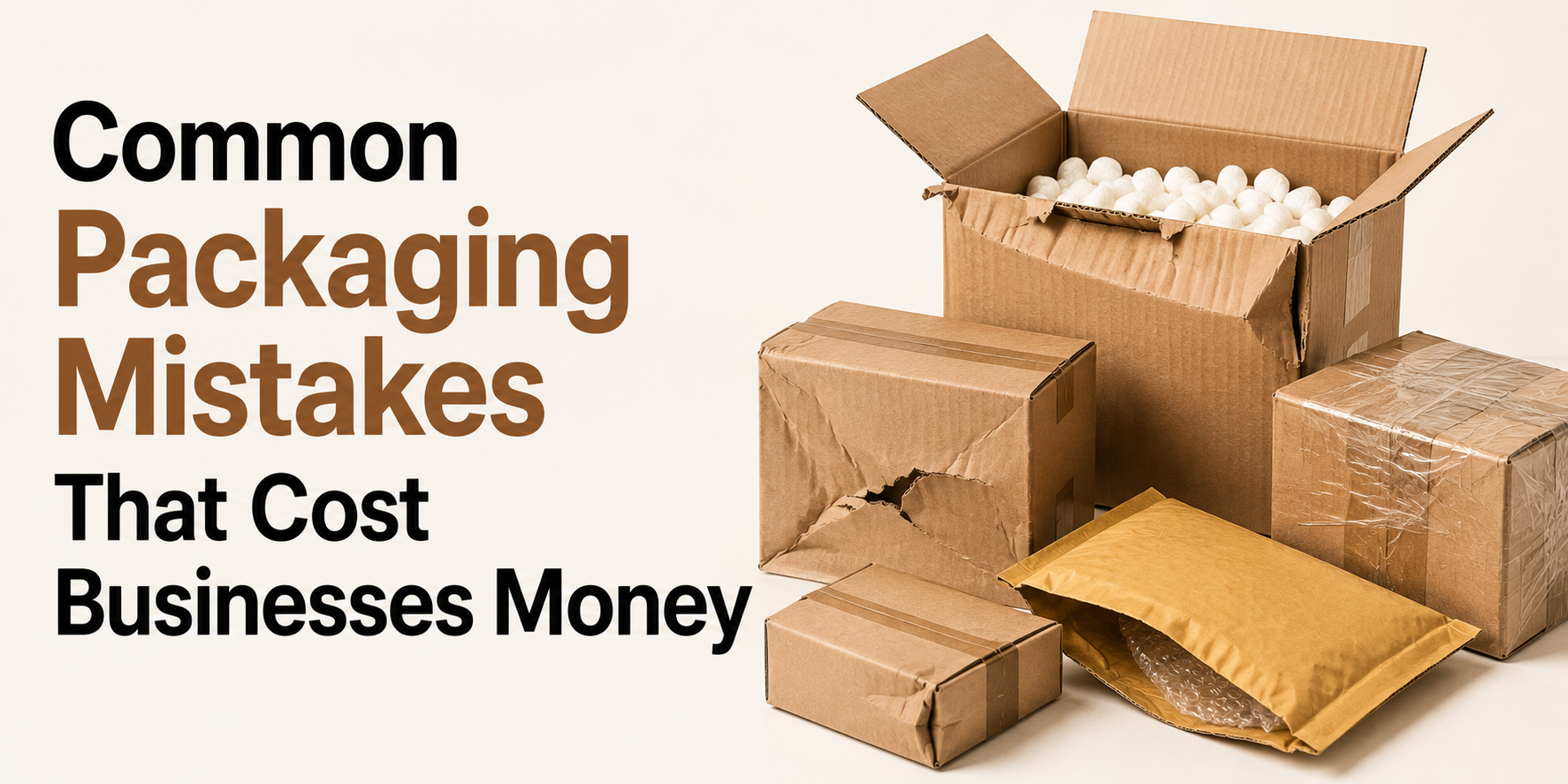
Packaging mistakes are expensive precisely because they're easy to overlook. A poor choice doesn't announce itself — it leaks money slowly through damaged goods, inflated shipping bills, wasted materials, and customers who don't come back. Because the cost is spread across thousands of small transactions, businesses often don't notice how much a packaging problem is really costing them until they add it up.
Here are the most common packaging mistakes and exactly how each one drains profit — so you can catch them before they do.
Mistake 1: Using oversized boxes
The single most common and most expensive packaging mistake is using boxes that are too big for the product. It feels harmless — a box is a box — but oversizing causes a cascade of costs. You pay to ship empty space under dimensional-weight pricing that charges by volume. The product shifts inside and takes damage it wouldn't in a snug box. The oversized box is itself more likely to be crushed. And customers who receive a small item in a giant box quietly question the brand's competence.
Right-sizing fixes all of these at once. It's one of the highest-return changes a business can make, cutting shipping cost, damage, waste, and negative impressions in a single move. Well-fitted custom packaging solutions eliminate this problem by matching the box to the product from the start.
Mistake 2: Under-protecting fragile products
The opposite error is just as costly: skimping on protection to save on materials. A few cents saved on cushioning is meaningless against the cost of a broken product — the refund, the return shipping, the replacement, the customer-service time, and the lost trust. Damaged deliveries are among the most expensive outcomes in e-commerce, and many of them are entirely preventable.
Matching material strength and cushioning to the fragility of the product isn't an expense; it's insurance that pays for itself many times over. The false economy of under-protection is one of the most common ways businesses lose money without realising the packaging was to blame.
Mistake 3: Choosing the cheapest box on unit price alone
Buying packaging on unit price is a trap. The cheapest box often becomes the most expensive once you account for the damage it fails to prevent, the returns it triggers, and the customers it disappoints. The right way to evaluate packaging is total cost — including shipping, damage, and experience — not the sticker price of the box.
Businesses that optimise for the lowest unit cost frequently end up paying far more in downstream problems. A slightly more expensive box that eliminates damage and delights customers is usually the cheaper option in reality.
Mistake 4: Ignoring the customer experience
Treating packaging as pure logistics ignores the fact that it's the customer's first physical contact with the brand. A generic, battered, or frustrating package undermines the whole purchase, making even a good product feel worse and reducing the chance of a repeat order. The cost here is invisible on a spreadsheet but real — lower loyalty, fewer repeat purchases, and less word of mouth.
Businesses that neglect the experience are leaving loyalty and referrals on the table. The package is an opportunity to build the relationship, and wasting it is a quiet but genuine cost.
Mistake 5: Inconsistent packaging
Inconsistent packaging — different looks, different quality across orders — prevents a brand from building recognition and trust. Every inconsistent package is a missed chance to reinforce the brand identity, and the customer never develops the familiarity that drives repeat business. The cost is a weaker brand that has to work harder for every sale.
Consistency compounds; inconsistency squanders that compounding. Businesses that don't standardise their packaging forfeit one of the easiest brand-building assets available.
Mistake 6: Wasteful, non-recyclable packaging
Excess plastic, non-recyclable materials, and unnecessary filler cost money directly through wasted material and indirectly through customer disapproval. Customers increasingly notice and resent packaging waste, and it damages the brand's image with a growing share of the market. Wasteful packaging is a double cost — you pay for materials you didn't need, and you pay again in lost goodwill.
Recyclable, right-sized packaging reduces both costs at once, saving material while improving the brand's standing with values-driven customers.
Mistake 7: Failing to communicate on the package
The package is a communication surface, and wasting it causes avoidable returns and support costs. When basic use instructions, care guidance, or a clear support path are missing, customers get confused, frustrated, and default to returning products they could have kept. Printing the answers to common questions where the customer will see them prevents returns and reduces support load.
The return that never happens is often the one where the customer found the answer on the box. Failing to communicate is a small omission with a recurring cost.
Mistake 8: Not testing packaging in real conditions
Assuming packaging will survive shipping without testing it is a gamble that frequently loses. Parcels face rough handling, stacking, and compression that a warehouse test doesn't replicate. Businesses that skip realistic testing discover their packaging's weaknesses through damage claims — the most expensive possible way to learn.
Testing actual packaging under realistic conditions is cheap compared to the cost of learning through broken deliveries.
Fixing the mistakes
The good news is that every one of these mistakes is fixable, and the fixes are straightforward:
-
Right-size your most-shipped products to cut cost, damage, and waste at once.
-
Match protection to fragility so damage stops eating your margins.
-
Evaluate total cost, not unit price.
-
Design for experience to protect loyalty and referrals.
-
Standardise packaging to build brand recognition.
-
Choose recyclable materials to save money and goodwill.
-
Communicate on the package to prevent avoidable returns.
-
Test in real conditions before problems find you.
The takeaway
Packaging mistakes are dangerous because they're quiet — they drain profit gradually through damage, waste, and lost customers rather than announcing themselves. But that also makes them one of the most controllable costs a business has. Auditing your packaging against these common errors and fixing what you find is one of the fastest ways to recover margin that's currently leaking away, one parcel at a time.

 English
 Arabic
 French
 Spanish
 Deutsch
 Turkish
 Dutch
Dutch
 Italiano
 Russian
 Romaian
 Portuguese (Brazil)
 Greek
Greek