


CRS Score vs FSW Points Difference: A Complete Guide to Canada's Two-Part Immigration System
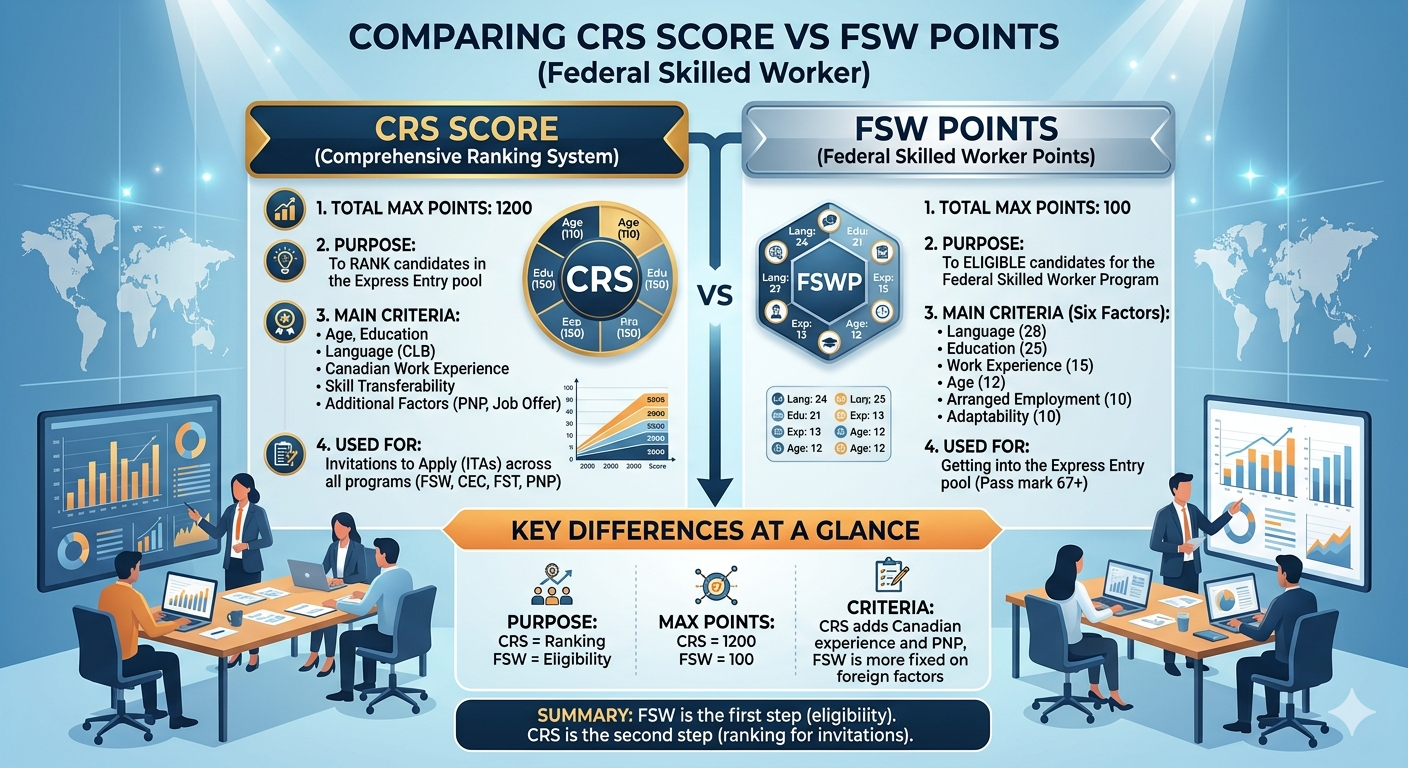
If you are applying for Canadian permanent residence through Express Entry, you have probably come across two different scoring systems and wondered what separates them. The CRS score vs FSW points difference is one of the most commonly misunderstood aspects of the entire Express Entry process. Many applicants think these two systems are interchangeable, but they serve completely different purposes within Canada's immigration framework.
This guide breaks down both systems in plain language, compares them side by side, answers the most frequently asked questions, crs score and gives you a clear picture of what you actually need to succeed in your application.
Category 1: What Are These Two Scoring Systems?
H2: Understanding the Federal Skilled Worker Points System
The Federal Skilled Worker (FSW) program is one of three immigration streams managed under Express Entry. Before a candidate can even create an Express Entry profile under FSW, they must pass a minimum eligibility threshold using the Federal Skilled Worker points grid.
This grid evaluates six core factors:
| FSW Factor | Maximum Points |
|---|---|
| Language ability (first official language) | 28 |
| Education | 25 |
| Work experience | 15 |
| Age | 12 |
| Arranged employment in Canada | 10 |
| Adaptability | 10 |
| Total Maximum | 100 |
To qualify for the FSW pool, a candidate must score at least 67 out of 100 on this grid. This is a binary gate: you either meet it or you do not. Passing 67 points does not guarantee an invitation; it simply makes you eligible to enter the pool.
Key FSW eligibility conditions beyond the points grid include:
- At least one year of continuous skilled work experience (NOC TEER 0, 1, 2, or 3) in the past 10 years
- Meeting the minimum language threshold (CLB 7 in all four abilities)
- Proof of sufficient settlement funds
H2: Understanding the Comprehensive Ranking System (CRS)
The Comprehensive Ranking System is an entirely separate points framework. It applies to all candidates inside the Express Entry pool, regardless of whether they entered via FSW, the Canadian Experience Class (CEC), or the Federal Skilled Trades program (FST).
The CRS ranks every profile in the pool against all other profiles. Immigration, Refugees and Citizenship Canada (IRCC) holds regular draws and issues Invitations to Apply (ITAs) to candidates above a certain CRS cutoff score.
The CRS has a maximum of 1,200 points and is structured across four main components:
| CRS Component | Maximum Points |
|---|---|
| Core human capital factors (single applicant) | 500 |
| Core human capital factors (with spouse/partner) | 460 |
| Spouse or common-law partner factors | 40 |
| Skill transferability factors | 100 |
| Additional points (job offer, nomination, Canadian study, siblings, French) | 600 |
| Total Maximum | 1,200 |
H2: Core Human Capital Breakdown (Single Applicant)
| Sub-Factor | Maximum Points |
|---|---|
| Age | 110 |
| Level of education | 150 |
| Official language proficiency (first language) | 136 |
| Official language proficiency (second language) | 24 |
| Canadian work experience | 80 |
| Subtotal | 500 |
Category 2: The Key Differences Between CRS and FSW Points
H2: Purpose and Function
The most important thing to understand about the CRS score vs FSW points difference is that they serve completely different functions:
| Feature | FSW Points Grid | CRS Score |
|---|---|---|
| Purpose | Determines eligibility for the FSW pool | Determines ranking within the Express Entry pool |
| Maximum score | 100 | 1,200 |
| Passing threshold | 67 points | No fixed threshold; depends on each draw |
| Who it applies to | FSW applicants only | All Express Entry profiles (FSW, CEC, FST) |
| Consequence of passing | Entry into the Express Entry pool | Invitation to Apply for permanent residence |
| When it is calculated | Before entering the pool | Once you are inside the pool |
Think of FSW points as the entrance exam and the CRS as the competition ranking. You need to pass the entrance exam first, and then you compete against others using your CRS score.
H2: What Factors Appear in Both Systems
Several factors appear in both frameworks but are weighted differently. This is a key source of confusion for applicants.
| Factor | FSW Weight (out of 100) | CRS Weight (out of 1,200) |
|---|---|---|
| Language (first language) | 28 | 136 (single) |
| Education | 25 | 150 |
| Age | 12 | 110 |
| Work experience (foreign) | 15 | Indirect (via transferability) |
| Canadian work experience | Not directly scored | 80 |
| Arranged employment | 10 | 50 (TEER 0) / 200 (NOC 00) |
| Adaptability | 10 | Included in other factors |
Notice that Canadian work experience carries zero direct weight in the FSW grid but carries significant weight in the CRS. This is why Canadian Experience Class candidates often achieve higher CRS scores even when their FSW points are the same as foreign-trained applicants.
H2: Language Scoring Comparison
Language proficiency is one of the highest-value factors in both systems, but the way it is calculated differs substantially.
FSW Language Scoring: Each language test score maps to a CLB level, and the FSW grid awards up to 28 points based on the first official language only.
| CLB Level | FSW Points (First Language) |
|---|---|
| CLB 9 or higher | 20-28 (based on ability) |
| CLB 8 | 16 |
| CLB 7 | 6 (minimum to qualify) |
| Below CLB 7 | Not eligible |
CRS Language Scoring: The CRS awards points for both first and second official languages and breaks scores down by the four abilities (speaking, listening, reading, writing).
| CLB Level | CRS Points Per Ability (First Language, Single) |
|---|---|
| CLB 10+ | 34 points per ability |
| CLB 9 | 31 |
| CLB 8 | 23 |
| CLB 7 | 17 |
| CLB 6 | 9 (second language only) |
| CLB 5 | 6 (second language only) |
A candidate who scores CLB 10 in all four abilities gains 136 CRS points from first language alone, compared to 28 FSW points. The ratio reflects how much more competitive the CRS framework is.
Category 3: How the Two Systems Work Together
H2: The Step-by-Step Journey from FSW Points to CRS Draw
Understanding the relationship between these two systems helps applicants plan more strategically. Here is how the process flows:
Step 1: Check FSW eligibility requirements Before anything else, confirm you meet the base requirements: NOC TEER 0, 1, 2, or 3 work experience, language minimum of CLB 7, educational credential assessment, and sufficient funds.
Step 2: Calculate your FSW points Using the six-factor grid, calculate whether you reach 67 or more. If you fall short, you may still enter the Express Entry pool through CEC or FST if you qualify through those streams.
Step 3: Create your Express Entry profile Once FSW eligibility is confirmed, you submit your profile into the Express Entry pool.
Step 4: CRS score is automatically assigned IRCC's system calculates your CRS score based on the detailed criteria above. This score is updated automatically if your circumstances change (new language test results, a job offer, a provincial nomination, etc.).
Step 5: Wait for a draw and receive an ITA IRCC conducts draws regularly. If your CRS score is at or above the minimum cutoff for a given draw, you receive an ITA and have 60 days to submit a complete application for permanent residence.
H2: Why a High FSW Score Does Not Guarantee a High CRS Score
This is a critical point that surprises many applicants. Someone can score 85/100 on the FSW grid but have a relatively average CRS score of 440. Here is why:
- The FSW grid is compressed into 100 points. Small differences between candidates are compressed into a narrow range.
- The CRS has 1,200 possible points and spreads those differences widely. A single CLB band difference in language can change your CRS by 50 or more points.
- The CRS rewards factors the FSW grid does not weigh heavily, such as Canadian work experience and provincial nominations.
- The CRS includes a bonus of up to 600 additional points for a provincial nominee certificate, a qualifying job offer, or other factors that simply do not exist in the FSW grid.
Category 4: CRS Cutoff Scores and What They Mean for FSW Applicants
H2: Historical CRS Cutoff Trends
CRS cutoffs vary by draw type. IRCC runs several types of draws:
| Draw Type | Approximate CRS Cutoff Range (Recent) |
|---|---|
| General (all streams) | 470 - 540+ |
| Canadian Experience Class only | 430 - 500 |
| French language proficiency | 335 - 380 |
| Category-based (STEM, healthcare, trades, etc.) | 430 - 500 |
| PNP-linked | 700+ (nominee certificates add 600 points) |
These numbers shift based on the size of the candidate pool, how many ITAs are issued per draw, and policy changes made by IRCC.
H2: What CRS Score Do FSW Applicants Typically Need?
Since FSW draws are now usually part of general all-program draws, FSW applicants compete alongside CEC and FST candidates. To be competitive in a general draw, most applicants need a CRS score in the range of 480 to 530 or higher.
Ways FSW applicants can boost their CRS score include:
- Improving language scores to CLB 10 or 11 in all abilities
- Obtaining a qualifying job offer from a Canadian employer (adds 50 or 200 points)
- Applying for a Provincial Nominee Program (PNP) stream, which adds 600 points upon nomination
- Gaining Canadian work experience to also qualify under CEC
- Completing a Canadian post-secondary credential (adds 30 CRS points)
- Having a sibling who is a Canadian citizen or permanent resident (adds 15 points)
- Improving French language skills (adds up to 50 bonus points and access to French-stream draws with lower cutoffs)
Category 5: Common Mistakes and Misconceptions
H2: Treating the Two Scores as the Same Thing
The biggest mistake applicants make when they research the CRS score vs FSW points difference is conflating the two scores. Someone who scores 80 on the FSW grid cannot compare that to a CRS score of 80. The scales are completely different. An FSW score of 80 is strong, while a CRS score of 80 would not come close to qualifying for any draw.
H2: Assuming FSW Points Determine Your ITA
FSW points determine eligibility, not invitation. Once you are in the pool, only your CRS score matters. A candidate with 95 FSW points but a CRS of 450 will wait longer for an ITA than a CEC candidate with a CRS of 510, even if the CEC candidate never scored on the FSW grid.
H2: Ignoring Skill Transferability Factors
The CRS includes a skill transferability component worth up to 100 points that does not exist in the FSW grid. This section rewards combinations of strong factors, such as:
| Combination | Maximum Bonus Points |
|---|---|
| Post-secondary education + strong first language (CLB 7+) | 50 |
| Post-secondary education + Canadian work experience | 50 |
| Foreign work experience + strong first language (CLB 7+) | 50 |
| Foreign work experience + Canadian work experience | 50 |
| Certificate of qualification (trade) + strong first language | 50 |
Each combination is capped at 50 points, and the overall transferability section is capped at 100 points total.
H2: Not Updating Your Profile Regularly
Your CRS score is not fixed. It changes when you:
- Retake a language test and score higher
- Cross a birthday and enter a new age bracket
- Receive a job offer
- Receive a provincial nomination
- Add a new educational credential
Many applicants submit their profile and forget to monitor it. Regularly reviewing your profile and updating any improved credentials can push your CRS score above the next draw's cutoff.
Conclusion
Understanding the CRS score vs FSW points difference is not just a technical exercise. It is the foundation of your entire Express Entry strategy. The FSW grid opens the door to the pool, while the CRS score determines whether and when you walk through it. If you want to improve your chances of receiving an ITA, focus your energy on boosting your CRS score through language improvement, provincial nominations, and Canadian experience rather than simply passing the FSW threshold. The CRS score vs FSW points difference is ultimately the difference between being eligible and being competitive.
Frequently Asked Questions (FAQs)
FAQ 1: What is the main CRS score vs FSW points difference that applicants should know?
The FSW points grid is an eligibility test that uses a maximum of 100 points to determine whether you can enter the Express Entry pool. The CRS, on the other hand, is a ranking tool with a maximum of 1,200 points used to compare all profiles in the pool and decide who receives an invitation to apply for permanent residence. Passing FSW points gets you into the pool; your CRS score determines whether you get an ITA.
FAQ 2: Can I be in the Express Entry pool without qualifying under FSW?
Yes. The Express Entry pool includes candidates from three programs: FSW, the Canadian Experience Class (CEC), and the Federal Skilled Trades (FST) program. If you have at least one year of skilled Canadian work experience, you may qualify under CEC without needing to meet the 67-point FSW threshold.
FAQ 3: Does a high FSW score automatically translate to a high CRS score?
Not necessarily. The two scoring systems weight factors differently and on very different scales. A candidate with a strong FSW score may have a moderate CRS score, particularly if they lack Canadian work experience or second-language proficiency, which the CRS rewards more heavily than the FSW grid does.
FAQ 4: How do language scores affect both the FSW and CRS calculations?
For FSW eligibility, you need a minimum of CLB 7 in each of the four language abilities, and the first official language score contributes up to 28 points. For the CRS, both first and second official languages are scored separately per ability, and strong first-language performance (CLB 10 across all abilities) can contribute 136 points. Better language scores remain one of the fastest ways to improve your CRS standing.
FAQ 5: What is the minimum CRS score needed to get an invitation to apply?
There is no fixed minimum. The CRS cutoff changes with every draw and depends on the type of draw (general, category-based, French, or PNP-linked), the number of ITAs being issued, and the overall composition of the candidate pool. General all-program draws in recent years have typically required CRS scores in the range of 470 to 540, though this varies widely.
FAQ 6: Does provincial nomination change my FSW points or my CRS score?
A provincial nomination adds 600 points directly to your CRS score, which is almost always enough to secure an ITA in the next available draw. It does not change your FSW eligibility points, since those are only used to determine pool entry and are not recalculated after you are inside the pool.
FAQ 7: If I barely passed 67 FSW points, is it worth submitting an Express Entry profile?
Yes, it is worth submitting a profile, particularly if you have other factors that could boost your CRS score. Even a relatively modest CRS score can lead to an ITA through category-based draws, French-language draws, or provincial nomination streams, all of which tend to have lower cutoff requirements than general draws.
FAQ 8: How often does IRCC conduct Express Entry draws, and how does that affect my CRS strategy?
IRCC typically conducts Express Entry draws every two to three weeks, though the schedule can vary. Each draw type targets different candidates. Understanding the difference between the CRS score and FSW points helps you plan which type of draw you are most likely to benefit from and which factors to improve first to cross the relevant cutoff threshold.

 English
 Arabic
 French
 Spanish
 Portuguese
 Deutsch
 Dutch
Dutch
 Italiano
 Russian
 Romaian
 Portuguese (Brazil)
 Greek
Greek