


Fleet of the Future: How Commercial Cargo Cycling Solutions Are Transforming Business Logistics
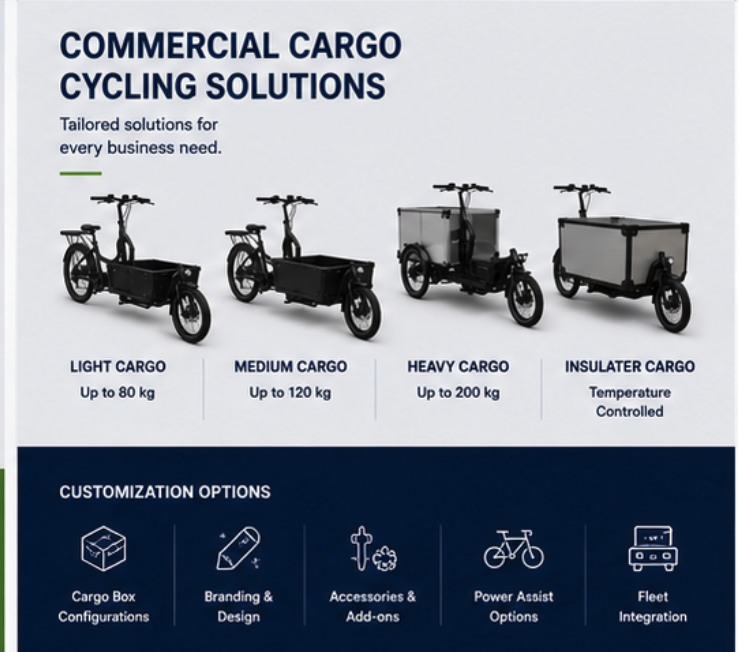
Electrifying a delivery fleet does not always mean buying electric vans. For many businesses, the most cost-effective and sustainable solution is smaller, lighter, and simpler: the cargo bike. Commercial Cargo Cycling Solutions encompass the vehicles, software, infrastructure, and operational practices needed to replace motorized delivery with pedal power. At the heart of these solutions are Heavy-Duty Utility Bicycles, engineered to withstand the rigors of daily commercial use while offering exceptional payload capacity and durability.
Building a Commercial Cargo Bike Fleet
Transitioning from vans to bikes requires more than just purchasing different vehicles. A successful implementation includes:
-
Vehicle selection: Matching bike types to delivery missions.
-
Micro-hub establishment: Securing urban depot space.
-
Rider recruitment and training: Finding and developing cargo bike couriers.
-
Route optimization: Using software designed for bike constraints.
-
Maintenance program: Keeping a commercial fleet operational.
-
Safety protocols: Protecting riders and the public.
Each element deserves careful attention. A bike that fails on route is not just an inconvenience—it is a missed delivery and a frustrated customer.
Vehicle Selection Matrix
Heavy-Duty Utility Bicycles come in several configurations, each suited to different commercial applications:
| Bike Type | Payload | Best For | Average Cost |
|---|---|---|---|
| Longtail | 100-150 kg | Light parcels, documents, food | $1,500-3,000 |
| Front-loader (2-wheel) | 150-200 kg | Groceries, bakery, small packages | $3,000-5,000 |
| Trike (front-loader) | 200-300 kg | Heavy parcels, tools, equipment | $4,000-7,000 |
| Box trike (enclosed) | 200-300 kg | E-commerce, pharmacy, high-value goods | $5,000-8,000 |
For most commercial applications, the box trike offers the best combination of stability, security, and capacity. The enclosed box protects parcels from weather and theft, while the three-wheel design allows the rider to stop without putting a foot down—a significant advantage when making 50+ stops daily.
The Micro-Hub Economics
A commercial cargo cycling solution is only as efficient as its depot network. The optimal model uses micro-hubs located within the delivery zone, rather than a single distant warehouse.
Consider a business delivering to a 10-square-mile urban area. A traditional van depot on the outskirts requires each driver to travel 5-10 miles (empty) to reach the delivery zone, then return. That is 10-20 miles of unproductive driving per vehicle per day.
A micro-hub located at the center of the delivery zone eliminates this deadhead mileage. Commercial Cargo Cycling Solutions can locate hubs in repurposed garages, shipping containers, or even dedicated street parking spaces with lockers.
Real estate costs are a consideration. A 500-square-foot micro-hub in a central location might cost $3,000-5,000 monthly. However, this cost is offset by eliminating van fuel, maintenance, depreciation, and parking tickets. Most operators find the micro-hub model reaches breakeven within 6-12 months.
Rider Recruitment and Retention
Cargo bike couriers are a different workforce than van drivers. Successful riders share several traits:
-
Physical fitness: Commercial cycling can burn 500-800 calories per hour.
-
Urban navigation skills: Knowledge of bike routes, shortcuts, and safe intersections.
-
Customer service orientation: Riders often interact directly with recipients.
-
Weather tolerance: The work continues rain or shine.
Recruitment strategies include partnering with local cycling clubs, offering competitive hourly wages ($20-30/hour in major cities), and providing high-quality gear (rain jackets, gloves, helmets). Retention improves with benefits like health insurance, performance bonuses, and clear advancement paths.
Route Optimization for Bikes
Standard logistics software is designed for vans—assuming highways, parking, and predictable speeds. Cargo bike routes require different optimization parameters:
-
Max slope: Steep hills may be unrideable with heavy loads.
-
Bike lane availability: Routes should prioritize protected bike infrastructure.
-
Stop density: Bikes excel with many stops in a small area.
-
Distance constraints: Most commercial cargo bike trips stay within 5-8 miles of the hub.
Specialized software (e.g., Routific, OptimoRoute) now includes cargo bike profiles, allowing dispatchers to optimize routes based on bike-specific constraints. Some solutions integrate real-time weather data, rerouting bikes away from expected thunderstorms or high winds.
Maintenance and Durability
Heavy-Duty Utility Bicycles experience far more wear than recreational bikes. A commercial cargo bike might log 5,000-10,000 miles annually, carrying hundreds of pounds daily. Maintenance priorities include:
-
Brakes: Hydraulic disc brakes need pad replacement every 1,000-2,000 miles.
-
Tires: Puncture-resistant tires with slime or tire liners reduce flats.
-
Drivetrain: Chains and cassettes wear faster under load; expect replacement every 2,000-3,000 miles.
-
Wheels: Heavy-duty spokes (13-14 gauge) and reinforced rims prevent breakage.
Forward-thinking fleet operators maintain in-house mechanics or contract with local bike shops for scheduled service. A well-maintained cargo bike can operate for 20,000+ miles before major component replacement.
Safety and Liability
Commercial cycling carries inherent risks. Businesses must implement safety protocols:
-
Helmet policy: Mandatory at all times.
-
High-visibility apparel: Reflective vests or jackets.
-
Lighting: Powerful front and rear lights, even during daytime.
-
Training: Defensive cycling, load management, and emergency braking.
-
Insurance: Commercial liability coverage for bicycle operations.
Some cities offer cargo bike safety courses specifically for commercial riders. These courses cover legal rights and responsibilities, intersection navigation, and load securement.
Conclusion
The shift from vans to bikes is not a niche experiment—it is a proven business strategy. Commercial Cargo Cycling Solutions offer lower operating costs, faster delivery times, and zero emissions. By deploying Heavy-Duty Utility Bicycles from urban micro-hubs, businesses can transform their logistics operations. The fleet of the future has two wheels, a pedal, and a box full of packages.

 English
 French
 Spanish
 Portuguese
 Deutsch
 Turkish
 Dutch
Dutch
 Italiano
 Russian
 Romaian
 Portuguese (Brazil)
 Greek
Greek