


Navigating the 2026 AI Wave: Why UAE Enterprises are Prioritizing Local Dynamics 365 Partners
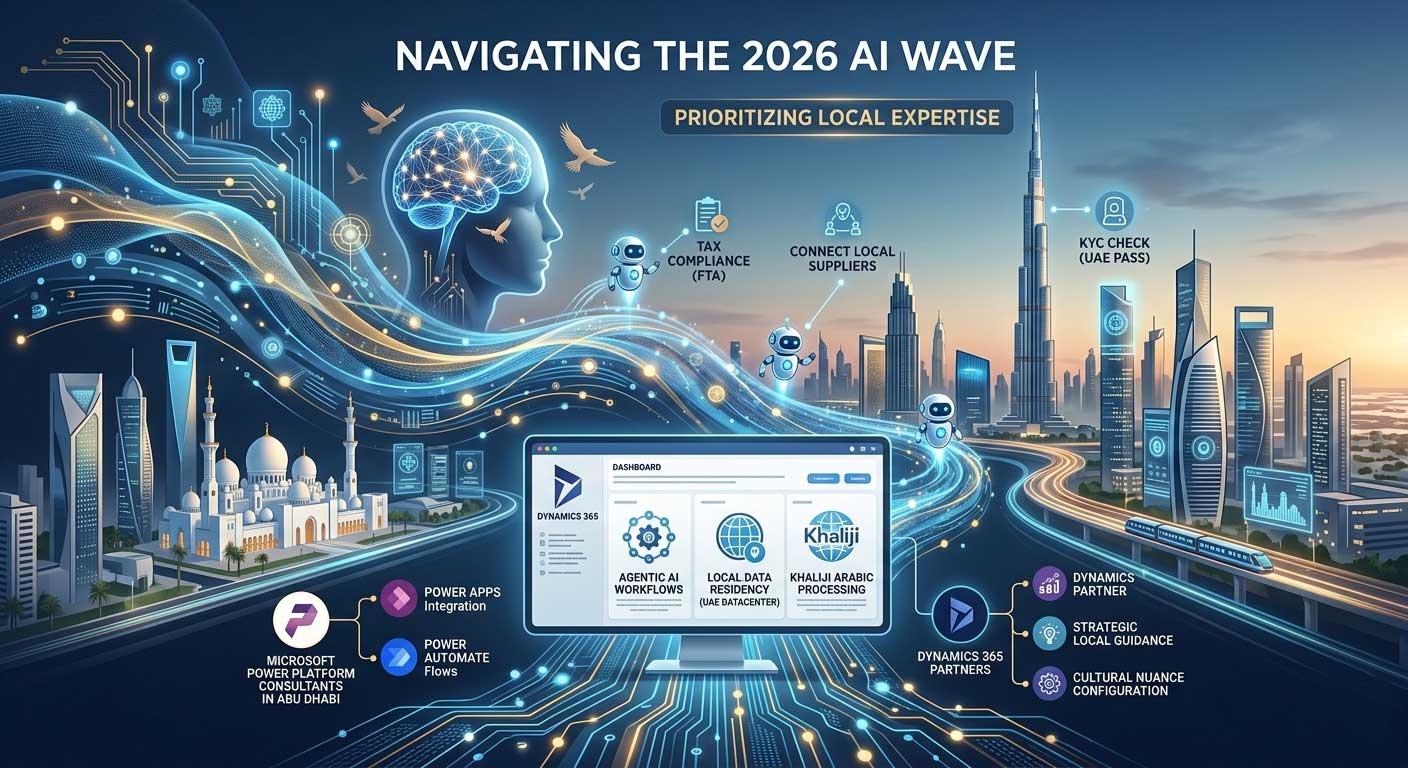
The landscape of business in the United Arab Emirates (UAE) is, quite literally, shimmering with potential. As we stand on the precipice of 2026, the rhetoric around Artificial Intelligence (AI) has shifted seismically from "buzzword" to "business imperative." For enterprises across Dubai, Abu Dhabi, and the Northern Emirates, the question isn’t if AI will redefine their operations, but how rapidly they can integrate it. This wave of intelligence is being driven, in large part, by the aggressive adoption of Microsoft’s "agentic AI"—the self-sufficient, task-oriented agents that are now a core part of the Microsoft Dynamics 365 and Power Platform ecosystems.
Yet, this rapid technological advancement presents a paradox. While the cloud allows for global implementation, the successful, compliant, and culturally resonant integration of AI requires a surprisingly hyperlocal approach. This is why forward-thinking UAE enterprises are no longer looking to generic global vendors but are, instead, prioritizing Dynamics 365 Partners with deep, on-the-ground experience in the Emirates. They are realizing that "AI in the cloud" is a global utility, but "AI in the UAE" is a local science.
The Agentic Shift: Dynamics 365 in 2026
To understand why local expertise is crucial, one must first understand the transformation of Dynamics 365. For years, Dynamics 365 was known as a robust suite of ERP (Enterprise Resource Planning) and CRM (Customer Relationship Management) solutions. By 2026, however, it has evolved into something far more sophisticated: the neural network of the modern enterprise.
Microsoft’s deployment of Copilot—and specifically, the move toward "agentic AI"—means that Dynamics 365 is no longer just a system of record where human employees input data. It is a system of intelligence that uses large language models (LLMs) to analyze data, anticipate problems, and autonomously execute complex workflows.
Imagine a supply chain agent in Dynamics 365 Supply Chain Management that detects a potential shipping delay from a global supplier. Instead of just notifying a human manager, the agent can, based on pre-set parameters, autonomously search for alternative local suppliers, verify their inventory, recalculate pricing for the affected production batch, and present the optimal recovery plan to the human manager for approval—all in seconds.
This level of autonomy is intoxicating for efficiency, but it introduces a host of localized complexities that only an experienced local implementation team can navigate.
1. The Language of the Emirates: Beyond Standard Arabic
The most immediate and critical challenge in deploying AI in the UAE is data localization, specifically around language. The UAE is a melting pot, yet Arabic remains the national and cultural language of commerce and regulation. While global AI models are "good" at standard Arabic, they often stumble when confronted with the nuances of localized business terminology or the specific Gulf (Khaliji) Arabic used in many internal documents or customer conversations.
For AI agents to truly operate effectively in CRM, they must understand not only what is being said, but the context in which it is said. For example, understanding the nuance of an email sent by a customer in Dubai, perhaps blending English with Arabic idioms, is essential for a customer service agent to provide a respectful and relevant response.
This is a key area where specialized Microsoft Power Platform consultants in Abu Dhabi and Dubai prove indispensable. They aren't just developers; they are consultants who work to localize the data and fine-tune the Copilot models to understand the specific linguistic and cultural landscape of the UAE. They help enterprises build a foundation of high-quality, localized data, ensuring that the AI’s conclusions are accurate, relevant, and respectful.
2. UAE Data Residency and "Hard-Line" Regulation
Data residency and compliance are perhaps the biggest inhibitors of cloud-based AI adoption globally, and the UAE is no exception. The UAE Data Protection Law (Federal Decree-Law No. 45 of 2021), combined with sectoral regulations from bodies like the Central Bank of the UAE and the Securities and Commodities Authority (SCA), dictates how data must be stored, processed, and accessed.
In 2026, the requirements have become even more stringent. Enterprises, especially those in government-linked sectors (G2B and G2C), banking, and critical infrastructure, cannot simply send sensitive data to a generic global datacenter for processing by a public LLM. They require data residency guarantees.
Microsoft has recognized this by investing in local datacenters in Abu Dhabi and Dubai, ensuring that Dynamics 365 customer data remains within the UAE's borders. However, configuration is key. Global integration partners, unaware of the specific auditing requirements of the UAE’s Federal Tax Authority (FTA) or the specific data sovereignty needs of an Abu Dhabi government entity, might misconfigure a Dynamics 365 implementation, leading to non-compliance risks.
Local partners bring this expertise. They can design hybrid architectures or ensure that data access controls are aligned with the latest UAE cybersecurity standards, providing enterprise leaders with peace of mind as they harness the power of AI.
3. The Low-Code Bridge: Power Platform in 2026
One of the most exciting aspects of Microsoft's 2026 strategy is the further convergence of Dynamics 365 and the Power Platform. AI is only as useful as the actions it can take. If a sales agent in Dynamics 365 Sales identifies a new high-value lead but cannot automatically trigger a complex verification process with external credit bureaus, its value is halved.
This is where the Power Platform—including Power Apps, Power Automate, and Power Virtual Agents (now part of Copilot Studio)—serves as the critical "glue" that binds the enterprise ecosystem together. The problem is, many critical verification and regulatory interfaces in the UAE are highly specialized and local.
For example, a property development firm in Abu Dhabi needs its Dynamics 365 system to integrate seamlessly with various municipal land departments and digital ID systems (like UAE Pass) for KYC (Know Your Customer) checks. Global Power Platform vendors have no experience with these specific, government-run interfaces. Local Dynamics 365 Partners, however, often already possess the pre-built connectors and experience to make these integrations a reality.
Furthermore, UAE enterprises often require bespoke functionality. A construction firm may need a custom Power App that allows site managers to capture job progress, which then automatically updates the main Dynamics 365 project module. A local partner knows how to build these solutions quickly, ensuring they integrate perfectly with the unique on-site processes common in the UAE construction sector.
4. Cultural Nuance in Automation and Audits
Artificial intelligence, when configured globally, works on global principles. But "how" business is done in the UAE can be quite different. A simple example is the structure of financial approvals or inter-company transactions. In the UAE, business groups are often highly diversified, with single entities managing multiple businesses under different licenses.
When a multi-entity Dynamics 365 system is implemented, a local partner understands how to structure the core system to manage complex tax reporting (VAT and Corporate Tax), inter-company eliminations, and consolidation—all of which are critical for FTA audits.
Moreover, the process of internal audit and compliance in the Gulf region places a high value on personal verification and manual oversight, even in automated systems. A generic global vendor might design an AI agent to handle the entire lifecycle of an invoice. A local partner knows that, while the AI can handle the mundane data entry and initial matching, a human approval step is usually culturally and legally required for final authorization. Local partners build this "human-in-the-loop" approach directly into the AI workflows.
Conclusion: Trust as the Cornerstone of Intelligence
As UAE enterprises look to navigate the complex AI wave of 2026, the most valuable currency is not the technology itself, but the trust placed in the partner implementing it. Intelligence without local resonance is simply efficiency without understanding.
While global technology providers create the tools, it is the local partners—those with an intimate knowledge of the UAE's language, regulation, culture, and specific market challenges—who transform those tools into true business value.
The enterprises that will lead the UAE in 2026 will be those that prioritize expertise over generic promises. They will be the ones who work closely with dedicated local Dynamics 365 Partners to build systems of intelligence that are not only powerful but also profoundly and authentically local. This investment in local expertise is the ultimate strategy for navigating the exciting, transformative, and undeniably intelligent future of business in the Emirates.

 English
 Arabic
 French
 Spanish
 Deutsch
 Turkish
 Dutch
Dutch
 Italiano
 Russian
 Romaian
 Portuguese (Brazil)
 Greek
Greek