


Relay-Based Switching Architecture in Climate Systems
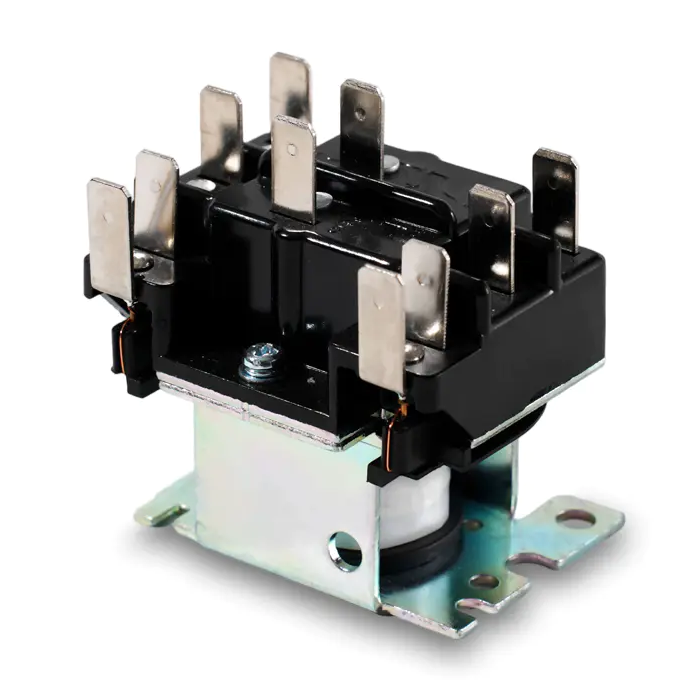
In modern HVAC engineering, electrical control architecture plays a critical role in ensuring system stability and efficiency. A central component in this architecture is the HVAC Control Relay, which functions as an interface between low-voltage control signals and high-power load devices such as compressors, fan motors, and heating elements.
A typical HVAC Control Relay operates with coil voltages ranging from 12V DC, 24V AC, or 24V DC, depending on system design. When the control signal energizes the coil, it generates a magnetic field that closes or opens the internal contacts. Contact ratings often range from 5A to 30A for PCB relays, while industrial-grade variants may handle up to 40A or more, especially in inductive load applications.
In HVAC systems, relay switching speed is usually within 10–20 ms response time, ensuring fast reaction to thermostat or controller commands. Electrical endurance is also a key parameter, with many relays rated for 100,000 to 1,000,000 mechanical cycles, depending on load type.
The HVAC Control Relay is commonly used in:
Indoor blower motor control
Compressor activation circuits
Defrost cycle switching in heat pumps
Auxiliary heater control
To handle inductive loads, suppression components such as RC snubbers or MOVs (Metal Oxide Varistors) are often integrated to reduce voltage spikes that may exceed 600V transient levels during switching events.
Thermal management is also important. Relay contact temperature rise is typically kept below 70°C under rated load conditions, ensuring long-term operational stability within HVAC control panels.

 English
 Arabic
 French
 Spanish
 Portuguese
 Deutsch
 Turkish
 Dutch
Dutch
 Italiano
 Russian
 Romaian
 Portuguese (Brazil)