


Industrial Automation in Hot Forging Processes
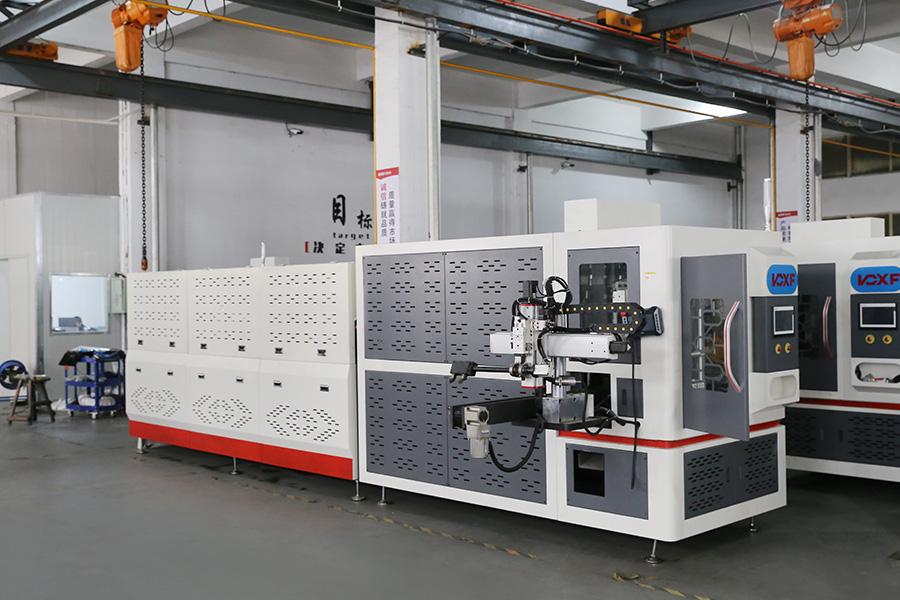
Fully Automatic Forging Machines are widely used in modern metal forming industries where precision, stability, and continuous production are required. These systems integrate mechanical presses, hydraulic units, feeding robots, heating furnaces, and programmable logic controllers (PLC) into a single coordinated production line.
In a typical configuration, a Fully Automatic Forging Machines system operates with a forging force range between 800 kN and 12,000 kN depending on the model and application. Stroke length often varies from 200 mm to 1100 mm, while working pressure systems are commonly designed around 25 MPa hydraulic pressure for stable force output. The cycle speed can be controlled between 10–150 mm/s depending on forging complexity and material type.
The automation system relies heavily on PLC control units that coordinate billet feeding, heating temperature control, die positioning, and ejection systems. Heating furnaces maintain billet temperatures between 1050°C and 1250°C for steel forging, ensuring proper plastic deformation conditions. Infrared sensors and thermal monitoring systems help maintain consistent temperature distribution during production cycles.
Structurally, these machines usually adopt H-frame or C-frame designs to improve rigidity and reduce deformation under high pressure loads. The ram system ensures vertical precision movement, often guided with hydraulic balancing systems to reduce vibration and mechanical wear.
Production efficiency depends on cycle time optimization. Some fully automated forging lines achieve cycle times close to 30 seconds per component in optimized configurations, especially when integrated with robotic feeding systems and automated die-changing modules.
From an engineering perspective, Fully Automatic Forging Machines are designed to reduce manual intervention, improve dimensional consistency, and maintain stable production quality over long operational periods. These systems are commonly applied in automotive components, rail systems, industrial tools, and structural hardware manufacturing.

 English
 Arabic
 Spanish
 Portuguese
 Deutsch
 Turkish
 Dutch
Dutch
 Italiano
 Russian
 Romaian
 Portuguese (Brazil)
 Greek
Greek