


Understanding Layered Cookware Performance
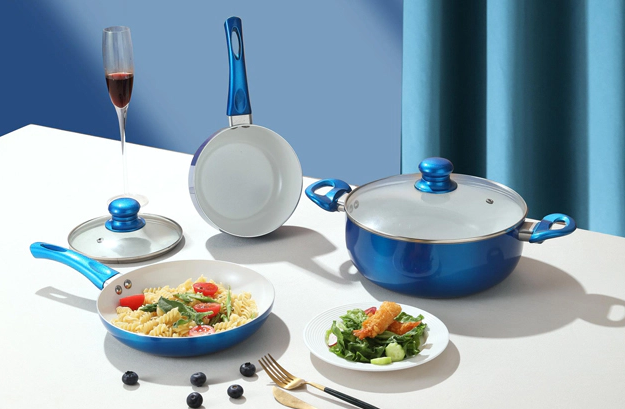
Cooking performance is closely linked to material structure, especially in Cooking Pots And Pans, where heat transfer efficiency defines how evenly food is prepared. Modern cookware is not just a metal container; it is often a layered thermal system designed to balance conductivity, durability, and food safety.
Most stainless steel cookware uses a tri-ply or multi-ply structure, typically consisting of:
Inner layer: 304 or 316 stainless steel (food-safe, corrosion-resistant)
Core layer: aluminum (thermal conductivity ~205 W/m·K)
Outer layer: magnetic stainless steel for induction compatibility
Aluminum improves heat distribution significantly compared to stainless steel alone, which has relatively low thermal conductivity (~14–16 W/m·K). This prevents hot spots during sautéing or simmering.
Typical technical specifications for mid-range cookware sets include:
Wall thickness: 2.0–3.5 mm
Base thickness: 4–8 mm (for heat stability)
Operating temperature: up to 260°C for most nonstick coatings
Induction compatibility: magnetic steel ≥ 430 grade
Nonstick coatings used in Cooking Pots And Pans often rely on PTFE or ceramic layers with surface roughness below 0.5 μm to reduce food adhesion. Ceramic coatings typically withstand higher peak temperatures but may lose performance faster under abrasive cleaning.
Thermal mass also plays a key role. Heavier pans with higher mass (1.2–2.5 kg for a 28 cm pan) retain heat more effectively, stabilizing cooking temperature during ingredient addition.
From a mechanical perspective, cookware design focuses on:
Thermal expansion matching between layers
Riveted or welded handle joints for load resistance
Warp resistance under repeated heating cycles
In summary, Cooking Pots And Pans are engineered systems where material science directly affects cooking consistency, energy efficiency, and usability.

 English
 Arabic
 French
 Spanish
 Portuguese
 Turkish
 Dutch
Dutch
 Italiano
 Russian
 Romaian
 Portuguese (Brazil)
 Greek
Greek