



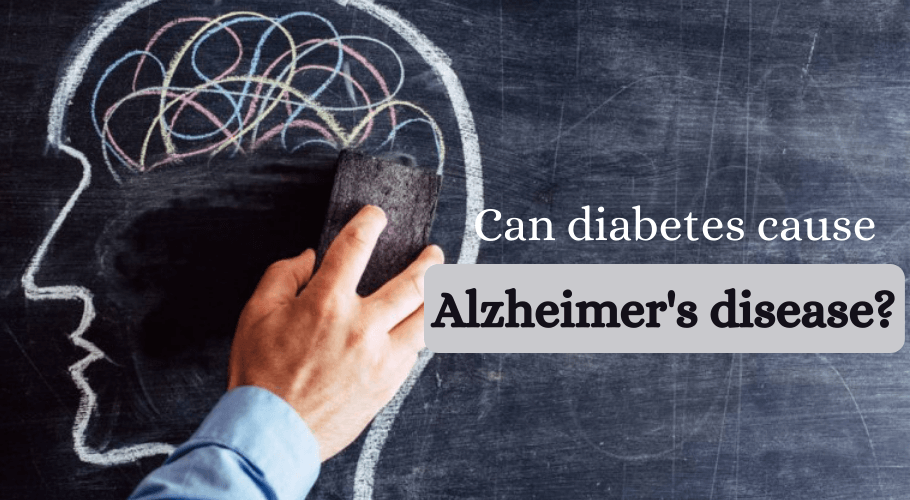
Does Diabetes Cause Alzheimer’s?
How does diabetes cause Alzheimer's disease?
To understand how diabetes may be linked to Alzheimer’s, it helps to start by understanding both these health problems. Diabetes is basically a condition brought on by insulin insensitivity, I.e. when the body either produces less insulin or is unable to use the insulin produced by the pancreas to move glucose from the bloodstream into the muscle cells where they can be used to create energy. When sugar levels rise in the blood, it begins to damage the blood vessels and nerves, leading to problems in almost every organ.
Alzheimer’s is a progressive brain disorder that damages memory, the ability to reason, communicate, and carry out everyday activities. It can also lead to personality changes—anxiety, agitation, and delusions, being the common ones.
Diabetes is also known to be the cause of other health problems, including:
Cardiac problems
Stroke
Eye problems
Kidney damage
Diabetic neuropathy—caused by nerve damage—indicated by pain/burning sensations in your feet or hands
Digestive problems
Infertility—in both sexes
Who is most at risk for Alzheimer's?
Why is age a risk factor for Alzheimer's?
Older populations are more vulnerable to Alzheimer’s. Industry statistics estimates show that one in eight people over 65 is at risk, while nearly half of all people over 85 already have it to some degree, or are suffering from other dementias.
Conclusion
Remember, even small changes can make a difference. So, if you’re suffering from diabetes. Start getting your blood sugar levels in the normal range today. With a proper diet-exercise-stress management routine, you can even completely reverse diabetes. Freedom from Diabetes regularly holds guided programs to help diabetics get free of the condition.
Browse full blog-
https://www.freedomfromdiabetes.org/blog/post/does-diabetes-cause-alzheimers/2653
Contact us :-
Mob : +91-7776077760
Email-Id : info@freedomfromdiabetes.org
Also connect with us on our website , Facebook page, and youtube
How does diabetes cause Alzheimer's disease?
To understand how diabetes may be linked to Alzheimer’s, it helps to start by understanding both these health problems. Diabetes is basically a condition brought on by insulin insensitivity, I.e. when the body either produces less insulin or is unable to use the insulin produced by the pancreas to move glucose from the bloodstream into the muscle cells where they can be used to create energy. When sugar levels rise in the blood, it begins to damage the blood vessels and nerves, leading to problems in almost every organ.
Alzheimer’s is a progressive brain disorder that damages memory, the ability to reason, communicate, and carry out everyday activities. It can also lead to personality changes—anxiety, agitation, and delusions, being the common ones.
Diabetes is also known to be the cause of other health problems, including:
Cardiac problems
Stroke
Eye problems
Kidney damage
Diabetic neuropathy—caused by nerve damage—indicated by pain/burning sensations in your feet or hands
Digestive problems
Infertility—in both sexes
Who is most at risk for Alzheimer's?
Why is age a risk factor for Alzheimer's?
Older populations are more vulnerable to Alzheimer’s. Industry statistics estimates show that one in eight people over 65 is at risk, while nearly half of all people over 85 already have it to some degree, or are suffering from other dementias.
Conclusion
Remember, even small changes can make a difference. So, if you’re suffering from diabetes. Start getting your blood sugar levels in the normal range today. With a proper diet-exercise-stress management routine, you can even completely reverse diabetes. Freedom from Diabetes regularly holds guided programs to help diabetics get free of the condition.
Browse full blog-
https://www.freedomfromdiabetes.org/blog/post/does-diabetes-cause-alzheimers/2653
Contact us :-
Mob : +91-7776077760
Email-Id : info@freedomfromdiabetes.org
Also connect with us on our website , Facebook page, and youtube
Does Diabetes Cause Alzheimer’s?
How does diabetes cause Alzheimer's disease?
To understand how diabetes may be linked to Alzheimer’s, it helps to start by understanding both these health problems. Diabetes is basically a condition brought on by insulin insensitivity, I.e. when the body either produces less insulin or is unable to use the insulin produced by the pancreas to move glucose from the bloodstream into the muscle cells where they can be used to create energy. When sugar levels rise in the blood, it begins to damage the blood vessels and nerves, leading to problems in almost every organ.
Alzheimer’s is a progressive brain disorder that damages memory, the ability to reason, communicate, and carry out everyday activities. It can also lead to personality changes—anxiety, agitation, and delusions, being the common ones.
Diabetes is also known to be the cause of other health problems, including:
Cardiac problems
Stroke
Eye problems
Kidney damage
Diabetic neuropathy—caused by nerve damage—indicated by pain/burning sensations in your feet or hands
Digestive problems
Infertility—in both sexes
Who is most at risk for Alzheimer's?
Why is age a risk factor for Alzheimer's?
Older populations are more vulnerable to Alzheimer’s. Industry statistics estimates show that one in eight people over 65 is at risk, while nearly half of all people over 85 already have it to some degree, or are suffering from other dementias.
Conclusion
Remember, even small changes can make a difference. So, if you’re suffering from diabetes. Start getting your blood sugar levels in the normal range today. With a proper diet-exercise-stress management routine, you can even completely reverse diabetes. Freedom from Diabetes regularly holds guided programs to help diabetics get free of the condition.
Browse full blog-
https://www.freedomfromdiabetes.org/blog/post/does-diabetes-cause-alzheimers/2653
Contact us :-
Mob : +91-7776077760
Email-Id : info@freedomfromdiabetes.org
Also connect with us on our website , Facebook page, and youtube
0 Commentaires
0 Parts
137 Vue
0 Aperçu





 English
 Arabic
 Spanish
 Portuguese
 Deutsch
 Turkish
 Dutch
Dutch
 Italiano
 Russian
 Romaian
 Portuguese (Brazil)
 Greek
Greek