


Safety First: How Vehicle Safety and Braking Solutions Protect Trucks, Drivers, and the Public
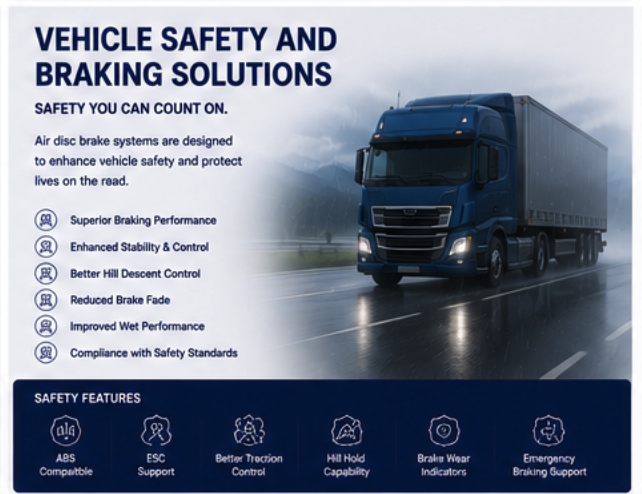
When an 80,000-pound semi-truck is traveling at highway speeds, the margin for error is razor-thin. Vehicle Safety and Braking Solutions are designed to maximize that margin, providing drivers with the stopping power and stability needed to avoid collisions. From foundation brakes to electronic stability control, every component works to prevent accidents before they happen. These solutions rely on Compressed Air Brake Systems to deliver the force needed to stop heavy vehicles safely.
The Layers of Braking Safety
Vehicle braking safety is layered, with each layer addressing different risks:
Layer 1: Foundation Brakes (Stopping Power)
The foundation brakes (disc or drum) are the primary stopping mechanism. Air disc brakes provide:
-
Shorter stopping distances: 15-25% shorter than drum brakes.
-
Better fade resistance: Consistent braking on long descents.
-
Self-adjusting: No manual adjustment needed.
-
Wet performance: Immediate braking after rain or puddles.
Layer 2: Anti-Lock Braking System (ABS)
ABS prevents wheel lockup during hard braking.
How ABS Works:
-
Wheel speed sensors detect impending lockup.
-
ABS control module sends a signal to ABS modulator valves.
-
Valves rapidly release and reapply air pressure to the brake chamber (multiple times per second).
-
The wheel continues to rotate, maintaining steering control.
Benefits of ABS:
-
Maintains steering control: The driver can steer around obstacles while braking.
-
Reduces stopping distance on slippery surfaces (ice, snow, wet pavement).
-
Prevents jackknifing: Tractor wheels do not lock up, maintaining trailer alignment.
-
Reduces tire flat-spotting: Locked wheels wear flat spots on tires.
Layer 3: Electronic Stability Control (ESC)
ESC prevents rollovers and loss of control.
How ESC Works:
-
Sensors monitor vehicle yaw rate (rotation), steering angle, and wheel speed.
-
If the system detects a loss of stability (e.g., the vehicle is skidding), it intervenes:
-
Reduces engine power (via engine control module).
-
Applies brakes to individual wheels to counter the skid.
-
-
ESC can prevent rollover by automatically braking the outside wheels during a sharp turn.
Effectiveness of ESC:
| Crash Type | Reduction with ESC |
|---|---|
| Single-vehicle tractor-trailer crashes | 30-40% |
| Rollover crashes | 50-60% |
| Loss-of-control crashes | 25-35% |
ESC is required on new tractors in the US (FMVSS 136) and Europe.
Layer 4: Traction Control (TCS)
Traction control prevents wheel spin on slippery surfaces.
How TCS Works:
-
Wheel speed sensors detect a spinning wheel (excessive speed compared to others).
-
The system applies brake pressure to the spinning wheel.
-
The engine control module may also reduce power.
-
Torque is transferred to the wheel with traction.
Layer 5: Collision Mitigation (Active Braking)
Advanced systems use radar and cameras to detect obstacles and brake automatically.
How Collision Mitigation Works:
-
Forward-facing radar detects vehicles, pedestrians, or obstacles ahead.
-
The system calculates time-to-collision.
-
If the driver does not brake, the system provides a warning (audible/visual).
-
If the driver still does not respond, the system applies the brakes automatically.
Effectiveness:
| Feature | Reduction in Rear-End Crashes |
|---|---|
| Forward collision warning (FCW) alone | 20-30% |
| Automatic emergency braking (AEB) | 50-60% |
| AEB + FCW | 60-70% |
AEB is rapidly becoming standard on new heavy trucks.
Layer 6: Brake Assist
Brake assist detects panic braking and applies maximum pressure immediately.
How Brake Assist Works:
-
The system monitors how quickly the driver presses the brake pedal.
-
If the pedal is depressed very rapidly (panic stop), the system interprets this as an emergency.
-
The system overrides the driver's pedal pressure and applies full braking force.
Why It Matters: In a panic situation, drivers often do not press the brake pedal hard enough, leaving stopping distance on the table.
Layer 7: Brake System Monitoring and Alerts
Modern systems monitor brake health and alert the driver to problems.
| Alert | Condition | Action |
|---|---|---|
| Low air pressure | Pressure below 65 psi | Warning light and buzzer |
| Excessive pushrod stroke | Brake out of adjustment | Warning light; vehicle may be placed out of service |
| Pad wear sensor | Pads near minimum thickness | Maintenance reminder |
| ABS fault | ABS component failure | Warning light; ABS disabled; service brakes still work |
| ESC fault | ESC component failure | Warning light; stability control disabled |
Air Disc Brakes as a Safety Upgrade
Compressed Air Brake Systems using disc brakes offer significant safety advantages over drums:
| Safety Metric | Drum Brake | Air Disc Brake | Improvement |
|---|---|---|---|
| Stopping distance (60 mph, loaded) | 250-300 ft | 200-240 ft | 15-25% |
| Brake fade (multiple stops) | Significant | Minimal | 50-75% improvement |
| Wet braking (first stop) | Poor (water trapped) | Excellent (water expelled) | 30-50% improvement |
| Pull during braking | Common (uneven shoe wear) | Rare (consistent pad wear) | Significant |
| Maintenance interval | 50,000-100,000 miles | 100,000-300,000 miles | 2-3x longer |
The Driver's Role in Braking Safety
Even the best Vehicle Safety and Braking Solutions cannot overcome poor driving practices. Drivers must:
-
Maintain following distance: At least 1 second for every 10 feet of vehicle length (e.g., 4 seconds for a 40-ft trailer).
-
Look ahead: Scan 12-15 seconds ahead for hazards.
-
Brake early and smoothly: Avoid panic stops; anticipate traffic flow.
-
Use engine brakes (retarders): Supplement foundation brakes on long descents.
-
Inspect brakes daily: Check for air leaks, pad wear, and stroke.
-
Respond to warnings: Never ignore low air pressure, ABS, or ESC warnings.
Fleet Safety Management
Fleet operators are responsible for ensuring braking systems are maintained:
| Practice | Benefit |
|---|---|
| Regular brake inspections | Identify wear before failure |
| Driver training | Teach proper braking techniques |
| Telematics monitoring | Track hard braking events; coach drivers |
| Maintenance compliance | Ensure brakes are within legal limits (pushrod stroke, pad thickness) |
| OEM-spec parts | Use quality replacement components |
The Future of Truck Braking Safety
-
Predictive braking: Using GPS and radar to anticipate braking needs (e.g., upcoming curves, traffic jams).
-
Brake-by-wire: Electronic pedal with no pneumatic line; faster response.
-
Integrated retarder control: Automatically engages engine brake when service brakes are applied on descents.
-
Wireless brake monitoring: Sensors transmit pad thickness and stroke data to fleet management.
-
Autonomous emergency braking (AEB) for pedestrians: Detects and brakes for pedestrians and cyclists.
Conclusion
Stopping a heavy truck safely requires layers of Vehicle Safety and Braking Solutions. Foundation brakes provide the stopping force. ABS maintains steering during hard braking. ESC prevents rollovers. Collision mitigation brakes automatically when the driver does not. Compressed Air Brake Systems deliver the power, and modern electronics add intelligence. Together, they protect truck drivers, passengers, and everyone sharing the road.

 English
 Arabic
 French
 Spanish
 Portuguese
 Deutsch
 Turkish
 Dutch
Dutch
 Italiano
 Russian
 Romaian
 Greek
Greek