


Tracking the Straight Line: How Linear Motion Detection Systems Measure Automotive Movement
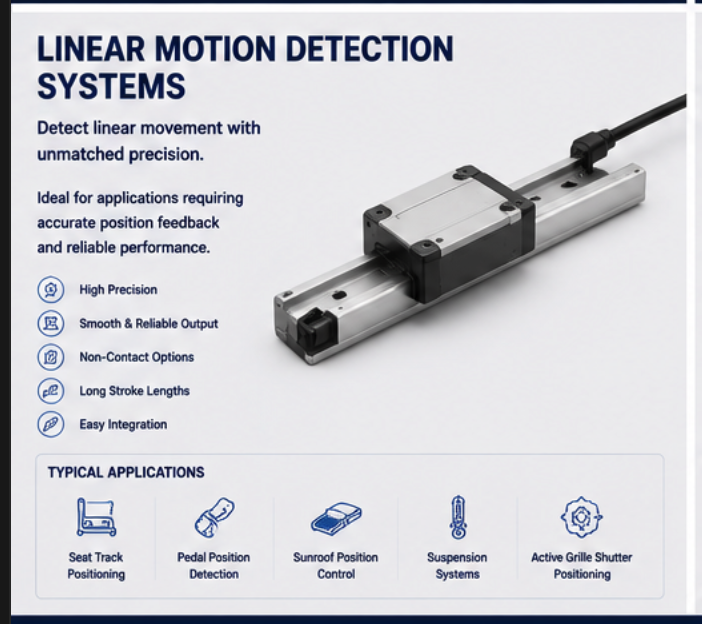
Not all motion in a vehicle is rotational. Pistons move up and down, pedals travel forward and backward, suspension components move in and out. Measuring these linear motions is the job of Linear Motion Detection Systems. These sensors track displacement along a straight line, providing essential data for engine management, ride control, and safety systems. They work alongside Automotive Sensor Integration Solutions to ensure that every moving component is precisely monitored.
Linear vs. Rotary Motion
First, a distinction: linear motion is straight-line movement; rotary motion is rotation around an axis. A piston moving up and down in a cylinder is linear. A camshaft rotating is rotary.
While many automotive sensors measure rotation (engine speed, wheel speed, steering angle), linear motion detection is equally important:
| Application | Linear Motion Measured |
|---|---|
| Brake pedal | Travel from resting position to fully depressed |
| Accelerator pedal | Travel from idle to wide-open throttle |
| Clutch pedal | Travel from engaged to disengaged |
| Suspension height | Vertical movement of wheel relative to chassis |
| Seat position | Fore-aft movement of seat |
| Gear shift lever | Linear travel between gear positions |
| Steering column | Telescoping movement (in/out) |
| Parking brake lever | Travel from released to fully applied |
Linear Sensing Technologies
Several technologies are used for Linear Motion Detection Systems:
Potentiometer (Contact):
-
How it works: A wiper slides along a resistive strip; resistance changes with position.
-
Pros: Inexpensive, simple.
-
Cons: Mechanical wear, limited life.
-
Applications: Older throttle pedals, seat position.
Hall Effect (Magnetic, Non-Contact):
-
How it works: A magnet moves along a linear path relative to a Hall sensor; output voltage varies with magnetic field strength (and thus position).
-
Pros: Non-contact (no wear), durable.
-
Cons: Requires careful magnetic design.
-
Applications: Modern throttle pedals, brake pedals.
Inductive (LVDT - Linear Variable Differential Transformer):
-
How it works: A moving core changes the mutual inductance between primary and secondary coils.
-
Pros: Extremely rugged, high precision, operates in harsh environments.
-
Cons: Expensive, larger.
-
Applications: Suspension height (active suspension), transmission position.
Magnetostrictive:
-
How it works: A pulse is sent down a wire; the position of a moving magnet creates a reflected pulse; the time delay indicates position.
-
Pros: Very high precision, long range.
-
Cons: Expensive.
-
Applications: Heavy-duty vehicle suspension, racing telemetry.
Pedal Position Sensing: The Driver Interface
The most familiar linear motion detection in a vehicle is pedal position.
Brake Pedal Position Sensor:
-
Function: Measures how far the driver presses the brake pedal.
-
Why it matters: In brake-by-wire and hybrid vehicles, the sensor determines braking force (friction vs. regenerative). It also controls brake lights.
-
Redundancy: Dual sensors (sometimes one contact, one magnetic) for safety.
-
Output: Typically 0.5V (released) to 4.5V (fully depressed).
Accelerator Pedal Position Sensor:
-
Function: Measures driver torque demand.
-
Technology: Non-contact magnetic (Hall effect) for durability.
-
Redundancy: Dual sensors with inverse scaling (e.g., Sensor A: 1V to 4V; Sensor B: 4V to 1V). If both move in the same direction, a fault exists.
Clutch Pedal Position Sensor:
-
Function: Measures clutch engagement for starting, rev-matching, and cruise control disengagement.
-
Applications: Manual transmission vehicles, some automated manuals.
-
Tip: Two sensors are often used: one at the top (fully engaged) and one at the bottom (disengaged).
Suspension Height Sensors: Keeping the Car Level
Suspension height sensors measure the distance between the chassis and the wheels (or axle). They are critical for:
Active Suspension:
-
The system adjusts damping or spring rate based on suspension position. A pothole might cause rapid extension; the system stiffens to prevent bottoming out.
Headlight Leveling:
-
As the vehicle accelerates or brakes, the nose rises or dips. Height sensors detect this and adjust headlight angle to prevent blinding oncoming drivers.
Load Leveling (Air Suspension):
-
When a heavy load is added (e.g., trailer tongue weight), the rear suspension compresses. Height sensors detect this and command air springs to inflate, restoring level ride height.
Technology: Suspension height sensors are often inductive (LVDT) or magnetostrictive because they operate in harsh environments (dirt, water, salt, vibration). They must be extremely rugged.
Seat and Steering Column Position Sensing
Memory seats and power-adjustable steering columns rely on linear motion detection:
Seat Position Sensors:
-
Measure fore-aft position, height, recline angle, and lumbar position.
-
Typically potentiometers (contact) because they are inexpensive and wear is acceptable (the seat is adjusted infrequently relative to pedals).
Steering Column Telescoping Sensor:
-
Measures how far the steering wheel is extended toward the driver.
-
Allows memory recall of driver preferences.
Gear Shift Position Sensing
Modern automatic transmissions use a linear (or sometimes rotary) sensor to detect the selected gear (PRNDL).
How it works:
-
A magnet is attached to the shift shaft. As the driver moves the lever, the magnet moves past Hall effect sensors. Each gear position has a unique combination of sensor activations.
Advantages:
-
Non-contact, no wear.
-
Can detect intermediate positions (e.g., driver holding the lever between R and N).
-
Provides input for reverse lights, neutral safety switch, and transmission control.
The Importance of Resolution and Accuracy
Linear motion detection systems are specified by:
-
Range: The total travel distance measured (e.g., 0-50 mm for a pedal).
-
Resolution: The smallest position change detectable (e.g., 0.1 mm).
-
Accuracy: How close the measurement is to the true position (e.g., ±0.5% of range).
-
Linearity: How consistently the output changes with position.
For a throttle pedal, 0.1 mm resolution is sufficient. For an active suspension system measuring high-frequency vibrations, 0.01 mm or better may be needed.
Calibration and Learning
Many Linear Motion Detection Systems require calibration after replacement:
-
Pedal sensors: The vehicle computer learns the minimum (resting) and maximum (fully depressed) positions. This is often done automatically as the driver uses the pedal.
-
Suspension height sensors: Require a scan tool to set the "zero" position (vehicle at nominal ride height).
-
Seat sensors: May require running the seat to its mechanical stops to learn limits.
Failure Modes and Symptoms
Linear motion detection sensors fail in characteristic ways:
| Sensor | Failure Symptom |
|---|---|
| Brake pedal sensor | Brake lights stuck on or off; no regenerative braking; cruise control won't disengage |
| Accelerator pedal sensor | No throttle response; engine stuck at idle; check engine light |
| Suspension height sensor | Headlights pointing at ground or sky; active suspension warning; uneven ride height |
| Seat position sensor | Memory seats don't work; seat moves to unexpected positions |
The Future of Linear Motion Detection
Emerging trends in Automotive Sensor Integration Solutions include:
-
Wireless linear sensors: Eliminating the wiring harness for moving components (e.g., suspension height sensors).
-
Sensor fusion: Combining linear position with acceleration data to predict future position (e.g., anticipating a pedal change based on how fast the driver is moving their foot).
-
Self-calibrating sensors: Sensors that learn their own range and zero point without driver intervention.
-
Printed sensors: Thin, flexible linear sensors embedded in seat fabric or pedal pads.
Conclusion
From the pedal under your foot to the suspension beneath the chassis, Linear Motion Detection Systems are constantly measuring the straight-line movements that make driving possible. These sensors provide critical data for engine control, braking, stability, and comfort systems. As part of broader Automotive Sensor Integration Solutions, they ensure that every linear motion is captured, interpreted, and acted upon. Measuring the straight line is just as important as measuring the circle.

 English
 Arabic
 French
 Spanish
 Portuguese
 Deutsch
 Turkish
 Dutch
Dutch
 Italiano
 Romaian
 Portuguese (Brazil)
 Greek
Greek